
Digital Asset Transparency: Building Trust in Gold-Backed Tokens

Trust does not come easily when real gold or silver backs a digital token, especially with your investment at stake. As the world of asset-backed tokens grows, clarity and proof about physical reserves are no longer optional—they are expected. The rise of verifiability and performativity approaches to transparency means you need consistent access to high-quality disclosures and ongoing signals of honest practices. This article helps you cut through uncertainty by showing how investors can demand—and verify—the full picture.
Table of Contents
- Defining Digital Asset Transparency Today
- Types of Transparency in Asset-Backed Tokens
- How Verification and Proof of Reserves Work
- Legal and Compliance Standards for Disclosure
- Investor Protections and Risk Mitigation
Key Takeaways
| Point | Details |
|---|---|
| Understanding Transparency | Transparency in digital assets involves both verifiability and performativity approaches, combining quality information with social trust-building practices. |
| Types of Transparency | Investors should evaluate multiple transparency types including reserve verification and operational transparency to ensure asset security and proper management. |
| Verification Importance | Proof of Reserves is crucial; independent audits must be sought to confirm asset backing, while continuous monitoring enhances trust. |
| Legal Compliance | Investors should verify that projects meet regulatory standards, as compliance enhances project legitimacy and operational stability. |
Defining Digital Asset Transparency Today
Transparency in digital assets has moved far beyond simple public disclosure. Today, it operates on two distinct levels that serve different purposes for investors like you. The verifiability approach treats transparency as intentionally shared, high-quality information characterized by clear disclosure, accuracy, and specific data points you can independently validate. This is what you see when a gold-backed token project publishes reserve audits, mining operation details, or blockchain transaction records. The performativity approach, meanwhile, recognizes that transparency functions as a social process with real consequences, meaning your trust gets built not just through documents but through consistent, repeated demonstration of honesty over time. Understanding transparency governance across digital platforms shows how these two perspectives work together to create accountability.
For asset-backed tokens specifically, transparency takes on additional weight because your investment ultimately depends on physical reserves existing exactly as claimed. Digital transformation has intensified expectations around transparency, making it central to accountability and trust mechanisms. When you evaluate a gold or silver-backed token project, you’re essentially checking whether the organization follows both approaches: they disclose verifiable information (audit reports, GPS coordinates of mining operations, blockchain records), and they demonstrate performative transparency through consistent communication, regular updates, and responsiveness to investor questions. This dual approach addresses what keeps many cryptocurrency investors awake at night: the fear that backing claims are fabricated or reserves have been sold without disclosure.
The complexity deepens when you factor in governance policies that balance privacy with trust. Asset-backed token projects must share enough information to prove reserves exist without exposing operational details that could compromise security or competitive advantage. They need to protect sensitive business data while enabling third-party audits and verification. This balancing act separates sophisticated, trustworthy projects from those making vague claims. You should expect transparency mechanisms that prove authenticity without creating new vulnerabilities, whether that means scheduled independent audits, blockchain-verified reserve tracking, or regulatory filings that undergo public scrutiny.
Pro tip: When evaluating any gold or silver-backed token project, request their most recent third-party audit report and cross-reference the reserve amounts listed against any blockchain transactions or public disclosures made in the same period to identify inconsistencies.
Types of Transparency in Asset-Backed Tokens
Asset-backed tokens operate across multiple transparency dimensions, each serving a distinct purpose in building investor confidence. The first type is reserve verification transparency, which focuses on proving that physical assets actually exist and match the claims made. This is where you see third-party audits, blockchain-verified holdings, and GPS-documented mining operations. When a project maintains comprehensive stablecoin reporting standards, it commits to consistent, verified disclosures about the assets backing each token. Reserve transparency answers the most pressing question investors ask: does the gold or silver really exist, or is this just digital fiction backed by promises? The second type is operational transparency, which reveals how the organization manages its assets, conducts business, and handles your investment. This includes disclosure of mining operations, refining processes, storage facilities, insurance arrangements, and the team members responsible for each function. You need to know not just that reserves exist, but that they’re being properly maintained, insured, and protected from loss or theft.
The third dimension is financial transparency, which goes beyond simple reserve statements to include audited financial statements, transaction histories, and fee structures. This type reveals how revenue flows through the organization, what percentage goes to operational costs versus shareholder returns, and whether there are hidden fees eroding your returns. Many investors overlook this until they notice their token balance declining faster than market fundamentals would justify. The fourth type is regulatory and compliance transparency, which demonstrates that the project operates within legal frameworks and meets jurisdictional requirements. This includes licensing documentation, regulatory filings, legal opinions, and compliance certifications that vary by country. A gold-backed token traded globally must navigate multiple regulatory environments, and transparency about how the project handles these obligations prevents you from holding an asset that could face sudden restrictions or seizure.
Finally, there’s communication transparency, which reflects how regularly and honestly project leadership engages with investors. This includes CEO updates, community forums, response times to investor questions, and acknowledgment of problems rather than silence. You should expect regular disclosures about reserve audits, project milestones, operational challenges, and any developments affecting token value. The interconnection among these five types creates a comprehensive transparency framework. A project might have excellent reserve verification but poor operational transparency, or strong financial disclosures paired with vague regulatory compliance details. Your due diligence should assess all five dimensions rather than focusing narrowly on any single one. When evaluating Maya Preferred tokens or similar offerings, examining how projects demonstrate gold-backed asset transformation shows whether they integrate these transparency types into their core operations.
Here is a comparison of transparency types and their importance for asset-backed token investors:
| Transparency Type | Core Purpose | Investor Benefit | Risk If Lacking |
|---|---|---|---|
| Reserve Verification | Prove existence of physical assets | Confidence assets back each token | Fake or missing reserves |
| Operational Transparency | Show how assets are managed | Assurance of proper safeguarding | Mishandling or theft |
| Financial Transparency | Disclose income and fee flows | Clear view of costs and revenue | Hidden losses or fees |
| Regulatory Compliance | Prove adherence to laws | Protection from legal surprises | Asset freezes or seizure |
| Communication | Regular updates and engagement | Early warning of project issues | Lack of trust, slow info |
Pro tip: Create a spreadsheet tracking each transparency type for projects you’re evaluating, scoring each on a scale of 1 to 5, then reviewing quarterly to catch any degradation in disclosure quality or responsiveness.
How Verification and Proof of Reserves Work
Proof of Reserves represents the backbone of trust in asset-backed tokens, but understanding how it actually works separates informed investors from those taking leaps of faith. At its core, Proof of Reserves (PoR) is a verification method where an independent third party confirms that the tokens circulating in the market are fully backed by actual physical assets held in secure locations. Think of it like a snapshot inspection: an auditor visits a gold storage facility, counts the bars, verifies their authenticity, and confirms that the total weight matches the token circulation. Reading attestation reports carefully helps you understand what these point-in-time checks actually prove and their limitations. The critical distinction here is that attestation reports are not the same as full audits. They verify reserve balances at a specific moment, ensuring the math checks out at that exact instant, but they don’t necessarily examine whether reserves were recently moved, borrowed, or encumbered by liens.
The verification process typically unfolds in three steps. First, the independent auditor or verification service receives access to reserve documentation and physical locations. Second, they conduct their inspection, testing, and confirmation procedures using standardized methodologies. Third, they publish their findings in a formal report that you can review. However, this process has a critical timing issue: a PoR snapshot taken on January 15 proves nothing about what happened on January 16. Some gold-backed token projects address this limitation through continuous monitoring systems, where cryptographic proofs and oracles monitor reserves in near real-time, automatically enforcing minting limits within smart contracts to prevent overissuance. This represents a significant advancement because it means reserves are being continuously verified rather than checked annually or quarterly.

When evaluating a project’s verification claims, pay attention to several specific details. Who conducted the verification: a major accounting firm like Deloitte, a smaller boutique auditor, or an in-house team? What exactly did they verify: physical gold bars, allocated storage certificates, or just bank account balances claiming gold exists somewhere? Were they allowed to conduct surprise inspections, or did the company schedule the audit months in advance? Did the auditor have unrestricted access to all storage facilities and documentation, or were certain areas off-limits? A project with transparency around its verification processes shows confidence in its claims, while vague language about “confidential verification partners” should raise immediate concerns.
The most robust verification frameworks combine multiple verification types. You might see quarterly attestation reports from a recognized accounting firm, supplemented by real-time blockchain monitoring of reserve transfers, plus annual audits with unannounced inspection components. This layered approach reduces the window for deception and ensures no single point of failure could hide reserve shortfalls. When examining token projects, request their most recent attestation reports and ask specific questions about verification methodologies, frequency, and independence levels.
Pro tip: Request the auditor’s independence letter and fee schedule separately from the attestation report to confirm the audit firm has no financial incentives to overlook discrepancies, then cross-reference reserve amounts against blockchain transaction records to spot any gaps between claimed and verifiable holdings.
Legal and Compliance Standards for Disclosure
The regulatory environment for asset-backed tokens has shifted dramatically over the past few years, moving from a gray zone of minimal oversight to a landscape where specific legal standards now govern what companies must disclose. If you hold or plan to invest in gold-backed tokens, understanding these compliance requirements becomes essential because they directly impact which projects can operate legally and which face future restrictions or shutdowns. The European Union has taken the lead with the Markets in Crypto-Assets Regulation (MiCA), which established uniform standards across all member states. MiCA’s comprehensive disclosure requirements mandate that token issuers provide detailed whitepapers explaining the asset backing mechanism, clear risk disclosures about what could go wrong, and ongoing reporting to regulators about reserve adequacy and token circulation. Beyond Europe, regulators in Singapore, Hong Kong, and increasingly in North America are adopting similar frameworks requiring detailed documentation about asset reserves, management structure, and operational controls.
The compliance burden extends far beyond simply publishing reserves. Asset-backed token projects must implement anti-money laundering (AML) and know-your-customer (KYC) procedures, meaning they need to verify who holds their tokens and monitor for suspicious activities. They must maintain detailed records of reserve movements, custody arrangements, and any encumbrances on those reserves. They need legal opinions confirming that their token structure complies with securities laws in jurisdictions where they operate. For many projects, this means engaging specialized legal counsel in multiple countries, conducting regular compliance audits, and maintaining documentation proving their adherence to evolving standards. These costs matter to you because they filter out bad actors but also add overhead that legitimate projects must pass along to investors.
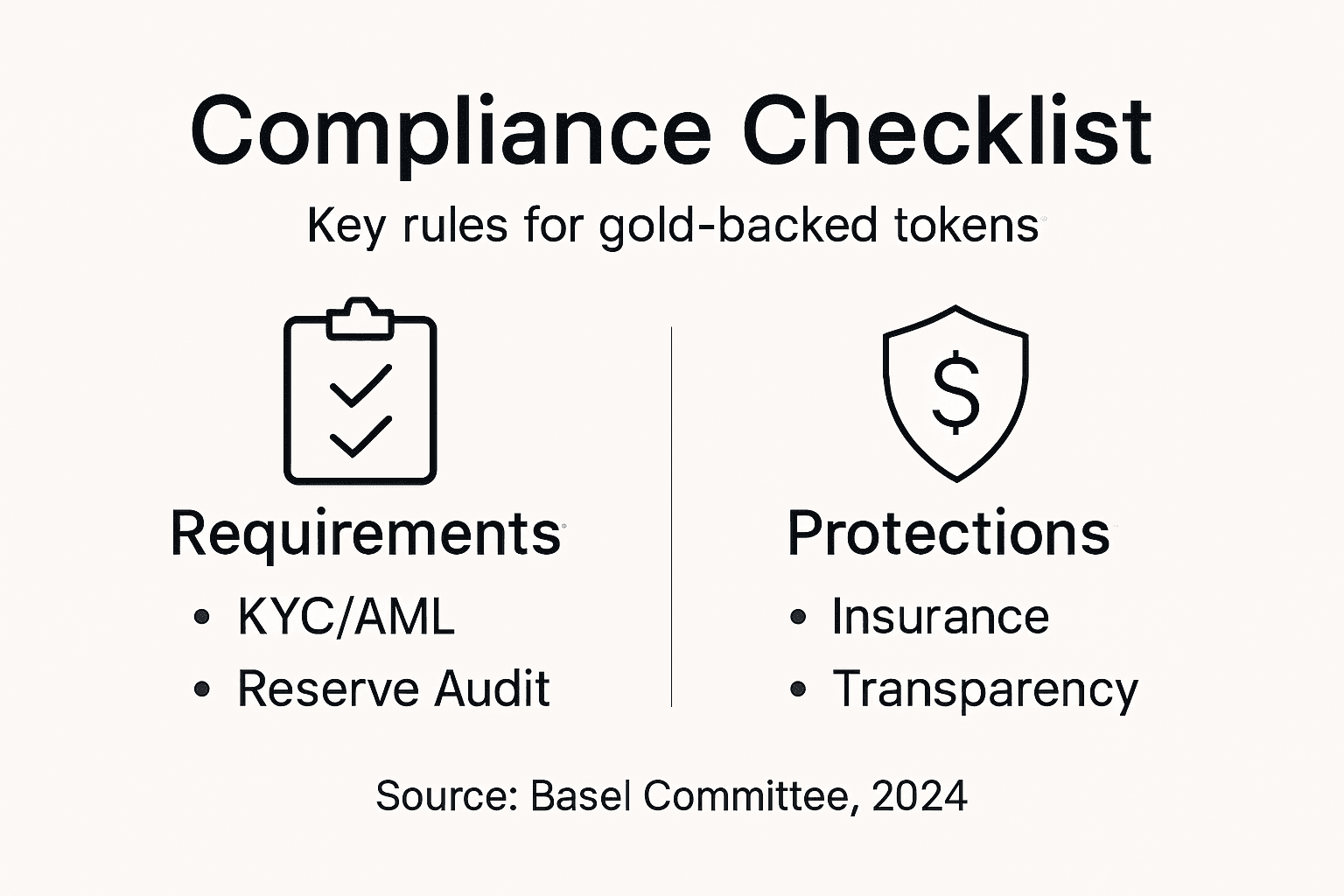
International banking standards have tightened further through frameworks like those issued by the Basel Committee on Banking Supervision. Banks now face strict disclosure requirements when holding or transacting in crypto-assets, which affects how financial institutions can support token projects. This creates a domino effect: if a bank cannot legally hold reserves backing a token due to inadequate disclosures by the token issuer, that token becomes practically unusable for mainstream investors. The criteria for what qualifies as adequately backed have also become stricter, meaning projects claiming gold backing must now prove it through methods that satisfy banking regulators, not just marketing claims on a website.
For you as an investor, this regulatory tightening is actually positive news. It means projects that survive the compliance gauntlet have undergone serious vetting, and regulators are actively supervising their operations. When evaluating any gold-backed token, request documentation showing compliance with MiCA (if applicable), copies of legal opinions from recognized firms, and details about their banking relationships. Projects unwilling to disclose compliance documentation should be treated with extreme skepticism, as they likely cannot meet current legal standards.
Pro tip: Check whether the project’s jurisdiction aligns with your residency and whether they maintain explicit legal compliance documentation for your region, as regulatory requirements differ significantly between the European Union, United States, Asia-Pacific, and other areas.
Investor Protections and Risk Mitigation
Investing in gold-backed tokens carries risks that differ significantly from either traditional gold ownership or pure cryptocurrency holdings. Understanding the protection mechanisms available to you is critical because these tokens exist in a hybrid space where neither traditional commodity regulations nor standard crypto frameworks fully apply. The primary protection comes from the physical assets themselves. Unlike purely digital cryptocurrencies where your investment depends entirely on adoption and market sentiment, gold-backed tokens provide portfolio diversification anchored in intrinsic physical value. During periods of market turbulence or geopolitical crisis, the underlying gold maintains value regardless of cryptocurrency market swings, functioning as a genuine hedge against systemic risks. This means your downside protection exists even if the token itself fails or the blockchain platform experiences problems.
Beyond the underlying assets, robust investor protections operate on multiple layers. Insurance provisions represent a critical safeguard that distinguishes professional gold-backed token projects from amateur operations. Projects should maintain comprehensive insurance covering physical storage, transit, theft, and operational risks. Ask specifically about insurance carriers, coverage amounts, and whether insurance policies remain in force continuously or only during audits. Custody arrangements also matter enormously. The gold should be held by independent custodians, not by the token issuer themselves, creating a separation that prevents management from accessing reserves for unauthorized purposes. You should be able to verify custodian identity through public filings or third-party confirmations. Regulatory licensing creates another protection layer. Projects operating under MiCA in Europe or under licensing frameworks in Singapore and Hong Kong have undergone regulatory scrutiny, which means authorities are actively supervising their operations and can intervene if problems emerge.
Technological safeguards add additional protection through smart contract design. Metal-backed tokens require specialized compliance frameworks including automated enforcement mechanisms that prevent overissuance of tokens beyond reserve backing. Some advanced projects implement real-time reserve monitoring through oracle networks that automatically restrict new token minting if reserves decline below required thresholds. This technological enforcement prevents the scenario where management could quietly issue excess tokens without corresponding gold backing. Transparent audits conducted by independent third parties provide ongoing verification, and increasingly, blockchain-based reserve tracking allows you to monitor reserve movements yourself rather than relying solely on periodic reports. The combination of physical custody separation, insurance, regulatory oversight, smart contract controls, and transparent auditing creates a multi-layered protection structure that significantly reduces the likelihood of catastrophic loss due to fraud or mismanagement.
The following table outlines key investor protections and the specific risks they help mitigate:
| Investor Protection | What It Addresses | Risk Reduced |
|---|---|---|
| Insurance Coverage | Loss from theft or disasters | Unrecoverable physical loss |
| Independent Custody | Issuer misuse of reserves | Misappropriation of assets |
| Regulatory Licensing | Non-compliance with rules | Project shutdown or penalties |
| Smart Contract Controls | Excess tokens in circulation | Overissuance, dilution |
| Third-Party Audits | Factual proof of reserves | Undetected fraud or gaps |
However, residual risks remain. Custody institutions could fail, storage facilities could experience natural disasters, regulatory environments could shift unfavorably, or project management could engage in subtle forms of misconduct. The solution is not to assume perfect safety but rather to diversify your gold-backed token holdings across multiple projects with different custody arrangements, insurance providers, and regulatory jurisdictions. No single token project should represent your entire precious metals allocation.
Pro tip: Create a comparison matrix of three to five gold-backed token projects, rating each on insurance coverage amounts, custodian independence, regulatory licensing status, and audit frequency, then allocate your investment proportionally rather than concentrating entirely in one project.
Achieving True Transparency with Gold-Backed Tokens
The challenge for investors today is finding a gold-backed token project that meets the highest standards of reserve verification, operational transparency, and regulatory compliance all at once. You want assurance that the physical gold truly exists, that it is protected, and that token issuance is strictly backed by those assets without hidden risks. Maya Preferred directly addresses these pain points by combining third-party audits, real-time blockchain proofs, and comprehensive legal disclosures to build genuine trust in digital assets backed by tangible commodities like gold and silver.
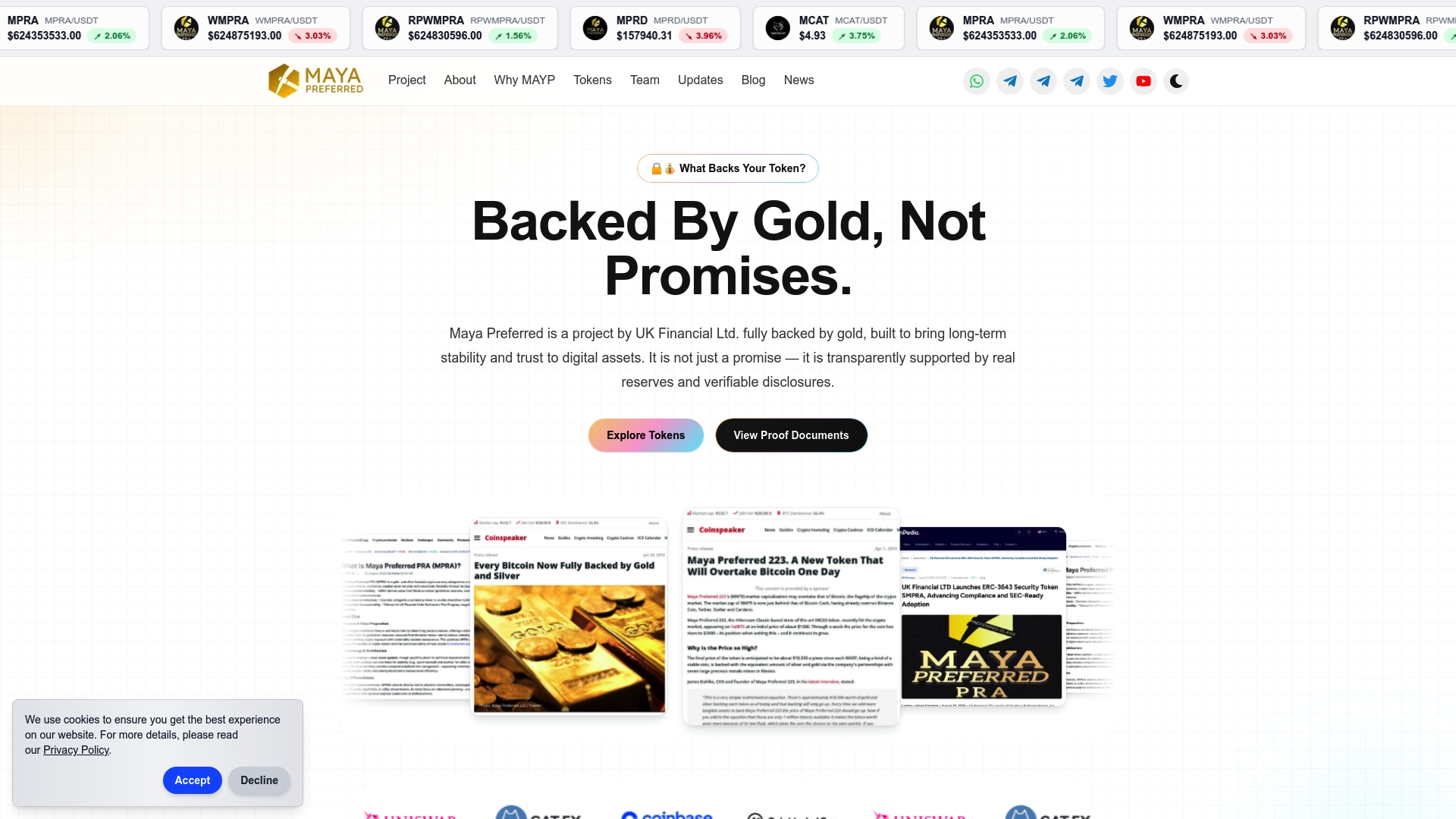
Explore how Maya Preferred integrates proof of reserves, clear communication from project leadership, and thorough compliance with international frameworks to protect your investment and reduce uncertainties. Don’t settle for promises without transparency. Take control of your precious metals portfolio with digital assets that prove their backing through rigor and openness. Visit Maya Preferred today to discover the MPRA, MPRD, and MCAT tokens. Learn more about our gold-backed asset transformation and review the detailed proof documents and audit reports that set us apart. Start your journey toward secure, transparent, and verifiable digital gold investment now.
Frequently Asked Questions
What are the main types of transparency in gold-backed tokens?
The main types of transparency in gold-backed tokens are reserve verification transparency, operational transparency, financial transparency, regulatory compliance transparency, and communication transparency. Each type plays a crucial role in building investor confidence by proving the existence and proper management of assets.
How does Proof of Reserves (PoR) work for gold-backed tokens?
Proof of Reserves is a verification method where an independent third party confirms that the tokens in circulation are fully backed by actual physical assets. This process includes an audit of the storage facilities, verification of the gold’s authenticity, and a formal report detailing the findings.
Why is regulatory compliance important for gold-backed token projects?
Regulatory compliance ensures that token projects operate within legal frameworks, thus protecting investors from uncertainties like asset seizures or sudden regulatory action. Projects that adhere to established regulations are subjected to oversight, which enhances their credibility and trustworthiness.
What kind of investor protections are available for gold-backed tokens?
Investor protections for gold-backed tokens include insurance coverage for physical assets, independent custody arrangements to prevent misuse of reserves, regulatory licensing to ensure compliance with laws, smart contract controls to prevent overissuance of tokens, and regular third-party audits to verify reserves. These measures collectively reduce investment risks.