
How Mining Protects Stablecoin Value and Trust

Price swings and skepticism remain constant challenges for those searching for reliable digital assets. Crypto investors and precious metals enthusiasts worldwide increasingly look for stablecoins with proven transparency and robust backing mechanisms. Mining provides the backbone for transaction security and value integrity by validating and recording every exchange on decentralized blockchains, ensuring stablecoins are trustworthy financial instruments in the global market.
Table of Contents
- Mining’s Critical Role In Stablecoins
- Types Of Asset-Backed Stablecoins Explained
- How Mining Projects Back Digital Tokens
- Transparency And Proof: Audits In Mining Support
- Risks, Costs, And Common Pitfalls
Key Takeaways
| Point | Details |
|---|---|
| Mining is Essential for Stablecoins | Mining validates transactions and secures digital assets, ensuring the reliability of stablecoins in volatile markets. |
| Types of Stablecoins | Four types exist: Fiat-Collateralized, Commodity-Backed, Crypto-Collateralized, and Algorithmic, each with unique stabilization strategies. |
| Importance of Transparency and Audits | Comprehensive audits enhance investor trust by confirming the legitimacy of asset backing and regulatory compliance. |
| Risks and Challenges | Investors should be aware of operational costs, regulatory complexities, and potential market manipulation when considering stablecoin investments. |
Mining’s Critical Role In Stablecoins
In the rapidly evolving world of digital finance, stablecoins have emerged as critical instruments for maintaining consistent value in volatile cryptocurrency markets. Mining plays a fundamental role in establishing and preserving the reliability of these digital assets, serving as the backbone of their transactional integrity and trustworthiness.
Blockchain mining ensures stablecoin stability through several key mechanisms. Decentralized consensus protocols validate each transaction, preventing fraudulent activities and maintaining the transparent record of digital asset movements. The mining process acts as a sophisticated verification system that:
- Prevents double-spending of digital assets
- Validates transaction authenticity
- Maintains an immutable transaction ledger
- Ensures network security through computational complexity
The technical infrastructure supporting mining goes far beyond simple transaction recording. Blockchain networks leverage complex computational processes where miners solve intricate mathematical problems, effectively creating a robust security framework that protects stablecoin value. Global financial infrastructure research demonstrates that this decentralized approach fundamentally differentiates stablecoins from traditional financial instruments by providing transparent, tamper-resistant transaction verification.
Mining transforms stablecoins from theoretical concepts into reliable financial tools, bridging the gap between digital innovation and trustworthy monetary systems.
By requiring significant computational work to validate transactions, mining introduces economic barriers that discourage malicious actors from manipulating the network. Miners must invest substantial computational resources, which creates a natural deterrent against potential fraud or systemic attacks. This economic model ensures that stablecoins remain stable, secure, and resistant to external manipulation.
Pro tip: Investors seeking reliable stablecoins should prioritize platforms with robust, transparent mining infrastructures that demonstrate consistent transaction validation and network security.
Types Of Asset-Backed Stablecoins Explained
Stablecoins represent a groundbreaking financial innovation designed to provide cryptocurrency investors with a reliable, low-volatility digital asset. Comprehensive financial research identifies four primary categories of stablecoins, each employing unique mechanisms to maintain value stability and minimize price fluctuations.
The four fundamental types of stablecoins include:
- Fiat-Collateralized Stablecoins: Directly backed by traditional currency reserves like US Dollars
- Commodity-Backed Stablecoins: Secured by physical assets such as gold, silver, or oil
- Crypto-Collateralized Stablecoins: Supported by other cryptocurrency reserves
- Algorithmic Stablecoins: Managed through complex mathematical supply-demand protocols
Fiat-Collateralized Stablecoins function most similarly to traditional financial instruments, with each digital token representing a corresponding unit of fiat currency held in reserve. This approach provides immediate credibility, as the underlying asset creates a direct value anchor. Banks and financial institutions typically manage these reserves, offering transparency through regular audits and comprehensive reporting.
Comparative market analysis reveals that commodity-backed and crypto-collateralized stablecoins introduce more complex stabilization mechanisms. Commodity-backed tokens derive value from physical assets like precious metals, while crypto-collateralized versions use overcollateralization strategies to maintain price stability, requiring more cryptocurrency in reserve than the stablecoin’s total value.
Algorithmic stablecoins represent the most experimental approach, using advanced mathematical models to dynamically adjust token supply and maintain consistent pricing.
Algorithmic stablecoins distinguish themselves by employing sophisticated computational methods to regulate token supply. Unlike traditional asset-backed models, these tokens expand or contract their circulating supply based on real-time market demand, creating an autonomous stabilization mechanism that responds instantly to price fluctuations.

Here is a breakdown of the four main stablecoin types and their stabilization methods:
| Stablecoin Type | Value Anchor | Stabilization Approach | Real-World Example |
|---|---|---|---|
| Fiat-Collateralized | Government currency reserves | Reserve audits and banking partners | Tether (USDT), USDC |
| Commodity-Backed | Physical assets (e.g., gold) | Asset audits and warehouse receipts | Tether Gold (XAUT) |
| Crypto-Collateralized | Other cryptocurrencies | Overcollateralization, smart contracts | DAI, sUSD |
| Algorithmic | No physical collateral | Programmatic supply adjustments | Ampleforth, FRAX |
Pro tip: Investors should carefully evaluate the backing mechanism and historical price stability of any stablecoin before making investment decisions.
How Mining Projects Back Digital Tokens
Digital tokens represent a sophisticated financial innovation that relies critically on mining infrastructure to establish credibility and value. Blockchain transaction validation serves as the fundamental mechanism through which mining projects create trust and legitimacy for digital assets, ensuring their integrity and preventing fraudulent activities.
Mining projects support digital tokens through several key operational strategies:
- Verifying transaction authenticity
- Preventing double-spending scenarios
- Maintaining transparent transaction ledgers
- Securing decentralized network infrastructure
- Generating cryptographic proof of asset ownership
Blockchain infrastructure provides the technical foundation for token backing, with miners performing complex computational tasks that validate and record each transaction. Global financial research demonstrates that these computational processes create an immutable record of token transactions, establishing a transparent and trustworthy ecosystem for digital assets.
Mining transforms digital tokens from theoretical concepts into verifiable, secure financial instruments with demonstrable value and ownership.
The consensus mechanisms employed by mining projects introduce economic barriers that protect digital tokens from manipulation. Miners must invest substantial computational resources to validate transactions, creating a robust security model that deters potential fraudsters and ensures the network’s overall stability. This approach fundamentally differentiates digital tokens from traditional financial instruments by providing real-time, transparent verification of asset movements.
Pro tip: Investors should examine a mining project’s computational infrastructure, consensus mechanisms, and historical network stability before committing to any digital token.
Transparency And Proof: Audits In Mining Support
Transparency represents the cornerstone of trust in digital asset ecosystems, particularly for stablecoins relying on complex mining infrastructures. Comprehensive audit mechanisms provide critical validation of mining operations, ensuring that digital tokens maintain genuine value and reliability.
The audit process for mining-supported stablecoins typically involves several essential verification strategies:
- Independent financial review of reserve assets
- Transaction validation and cryptographic proof checking
- Compliance verification with regulatory standards
- Technical infrastructure security assessment
- Comprehensive computational resource documentation
Blockchain auditing goes beyond traditional financial reviews by providing granular, cryptographically verifiable evidence of asset backing. Systematic empirical research demonstrates that transparent disclosure of mining data significantly reduces investor risks and enhances overall ecosystem credibility.
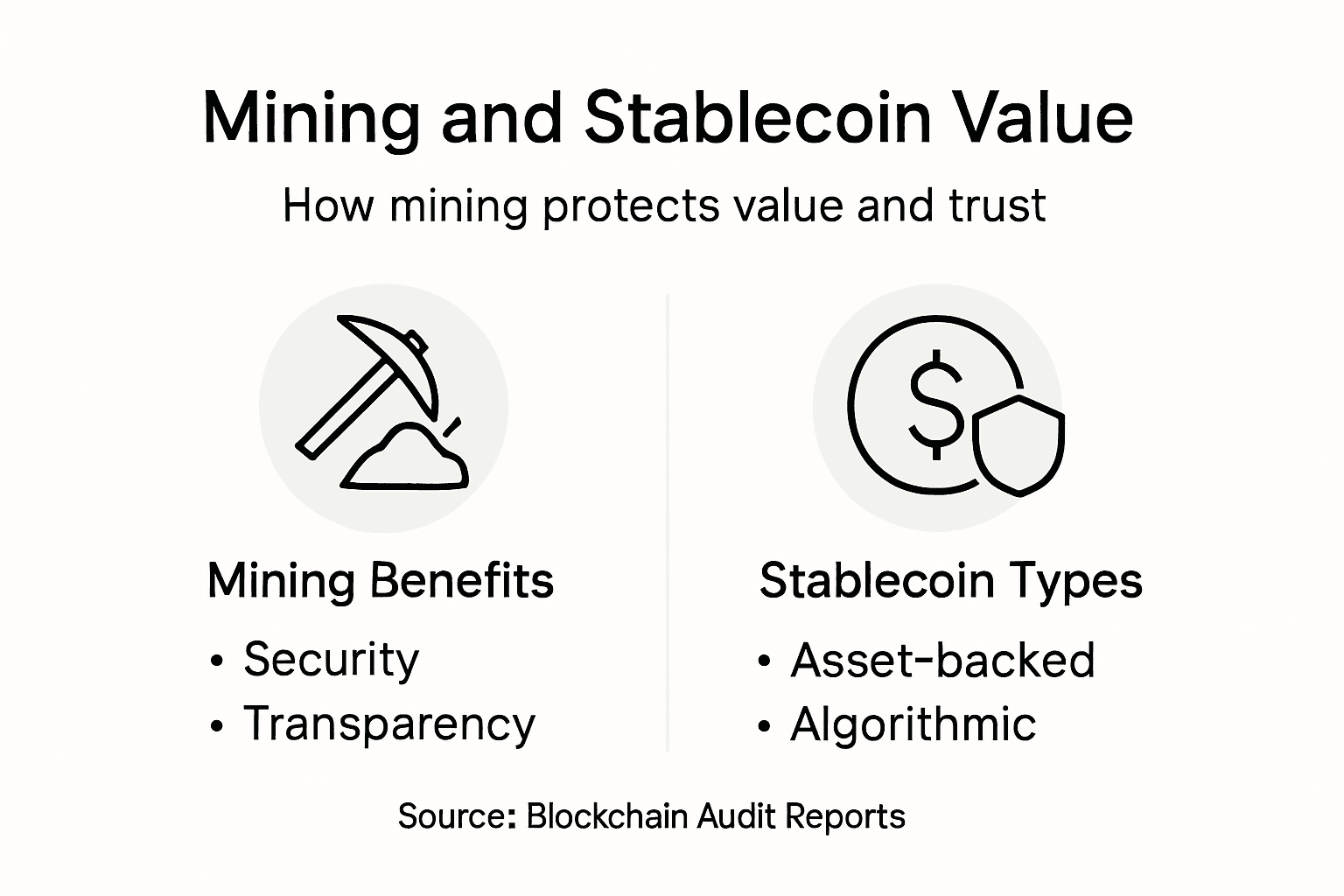
Below is a summary of audit features that enhance transparency and trust in mining-backed stablecoins:
| Audit Feature | Purpose | Benefit to Investors |
|---|---|---|
| Reserve Verification | Confirms backing assets exist | Reduces risk of under-collateralization |
| Cryptographic Proofs | Verifies transaction authenticity | Increases trust in transaction validity |
| Regulatory Compliance | Assesses legal adherence | Lowers legal and regulatory risks |
| Security Assessments | Evaluates technical infrastructure | Enhances overall network safety |
Rigorous auditing transforms stablecoins from speculative instruments into credible, verifiable financial assets.
The verification process requires mining projects to demonstrate not just the existence of assets, but their ongoing liquidity, authenticity, and alignment with promised backing mechanisms. By subjecting mining operations to continuous, transparent scrutiny, these audits create a robust framework that protects investor interests and maintains the fundamental promise of stablecoin value preservation.
Pro tip: Always request and independently verify the most recent audit documentation before investing in any mining-backed digital token.
Risks, Costs, And Common Pitfalls
Stablecoins represent innovative digital assets, but they are not without significant challenges that investors and developers must carefully navigate. Complex financial risks underscore the need for comprehensive understanding of potential vulnerabilities in mining-backed digital tokens.
The primary risks associated with stablecoin mining and infrastructure include:
- Collateral liquidity uncertainty
- High operational infrastructure costs
- Regulatory compliance complexities
- Energy consumption challenges
- Technical infrastructure vulnerabilities
- Market manipulation potential
- Cross-border jurisdiction conflicts
Mining infrastructure demands substantial financial investment, with operational expenses extending far beyond simple computational requirements. Global financial analysis reveals that maintaining robust mining operations involves significant hardware investments, continuous technical upgrades, and complex risk management strategies.
Successful stablecoin projects balance technological innovation with rigorous risk mitigation strategies.
The most critical pitfalls emerge from inadequate collateral management and insufficient transparency. Stablecoin projects must continuously demonstrate their ability to maintain consistent asset backing, prevent market manipulation, and respond effectively to potential de-pegging scenarios. This requires sophisticated monitoring systems, real-time liquidity assessments, and proactive governance mechanisms that can rapidly address emerging financial risks.
Pro tip: Conduct thorough due diligence by examining a stablecoin project’s historical performance, audit records, and risk management protocols before making any investment decisions.
Secure Your Investment with Transparent Gold and Silver-Backed Stablecoins
The article highlights how mining safeguards stablecoin value and fosters trust through rigorous transaction validation and economic security. If you seek stablecoins anchored in tangible assets alongside transparent auditing and robust mining-backed infrastructure you face challenges like volatility risk and lack of proof of reserves. Maya Preferred addresses these concerns by offering blockchain tokens fully backed by real-world gold and silver reserves supported with detailed proof documentation and continuous transparency.

Explore how Maya Preferred’s MPRA, MPRD, and MCAT tokens merge precious metals stability with verified mining projects ensuring asset authenticity and network security. Visit the Maya Preferred official site to access comprehensive audits, regulatory updates, and community insights. Take control of your digital asset portfolio by investing in credible, asset-backed stablecoins designed to protect your value in today’s volatile markets.
Frequently Asked Questions
What role does mining play in maintaining stablecoin value?
Mining ensures the stability of stablecoins by validating transactions, preventing double-spending, and maintaining a transparent and secure ledger, which reinforces the trustworthiness of these digital assets.
How do different types of stablecoins utilize mining?
Each type of stablecoin, such as fiat-collateralized, commodity-backed, crypto-collateralized, and algorithmic, is supported by mining in various ways. Mining provides the necessary transaction validation and security, but the underlying mechanisms differ based on the stablecoin type.
What are the risks associated with mining-backed stablecoins?
Risks include collateral liquidity uncertainty, high operational costs, regulatory compliance challenges, technical vulnerabilities, and potential market manipulation, which can affect the stability and trust in stablecoins.
Why are audits important for mining-supported stablecoins?
Audits are crucial because they verify the existence of backing assets, check transaction validity, assess compliance with regulations, and evaluate security measures, thereby enhancing transparency and investor trust in mining-supported stablecoins.