
Real-World Assets vs Fiat-Backed Crypto: Key Investor Impacts

Seeking stability in volatile markets pushes many Asian and European investors to explore new ways of preserving capital. Gold and silver-backed cryptocurrencies combine established asset value with blockchain security, creating digital tokens tied directly to physical reserves. This approach offers clarity, transparency, and regulatory compliance while addressing long-term wealth protection needs. Discover how real-world assets and fiat-backed crypto models deliver distinct advantages for investors who prioritize asset verification, risk reduction, and lasting security in every transaction.
Table of Contents
- Defining Real-World Assets And Fiat-Backed Crypto
- Types Of Asset-Backed Tokens Explained
- Tokenization Process And Reserve Proofs
- Benefits And Use Cases For Investors
- Risks, Regulatory Oversight, And Comparisons
Key Takeaways
| Point | Details |
|---|---|
| Real-World Assets Offer Stability | Tokens backed by physical assets provide a more stable and transparent investment compared to traditional cryptocurrencies. |
| Fiat-Backed Cryptocurrencies Ensure Price Stability | These tokens maintain value by pegging to traditional currencies, though they carry regulatory and institutional risks. |
| Investors Should Assess Risk and Transparency | Evaluating the backing, governance, and regulatory compliance of each token is crucial before investing. |
| Tokenization Facilitates Diverse Investment Opportunities | Digital assets offer an innovative means for investors to access previously illiquid asset classes with reduced barriers. |
Defining Real-World Assets and Fiat-Backed Crypto
In the evolving world of digital finance, real-world assets and fiat-backed cryptocurrencies represent two distinct approaches to creating stable digital financial instruments. Blockchain-based asset tokenization enables investors to bridge traditional financial systems with digital innovation, transforming how we perceive value and investment opportunities.
Real-world assets are tangible or financial resources from the physical economy that become digitally represented through blockchain technology. These can include precious metals, real estate, commodities, or financial instruments like bonds and securities. Unlike traditional cryptocurrencies with volatile valuations, real-world asset tokens derive their value directly from underlying physical assets, providing a more stable and transparent investment mechanism. The key advantage is that each token represents a verifiable claim on a specific, measurable asset with intrinsic economic value.
Fiat-backed cryptocurrencies, in contrast, are digital tokens designed to maintain a stable value by being directly pegged to traditional government-issued currencies like the US Dollar or Euro. Stablecoin mechanisms rely on financial intermediaries holding reserve balances equivalent to the tokens in circulation. However, these instruments carry inherent risks associated with traditional financial systems, including potential regulatory changes and the financial health of the backing institutions.
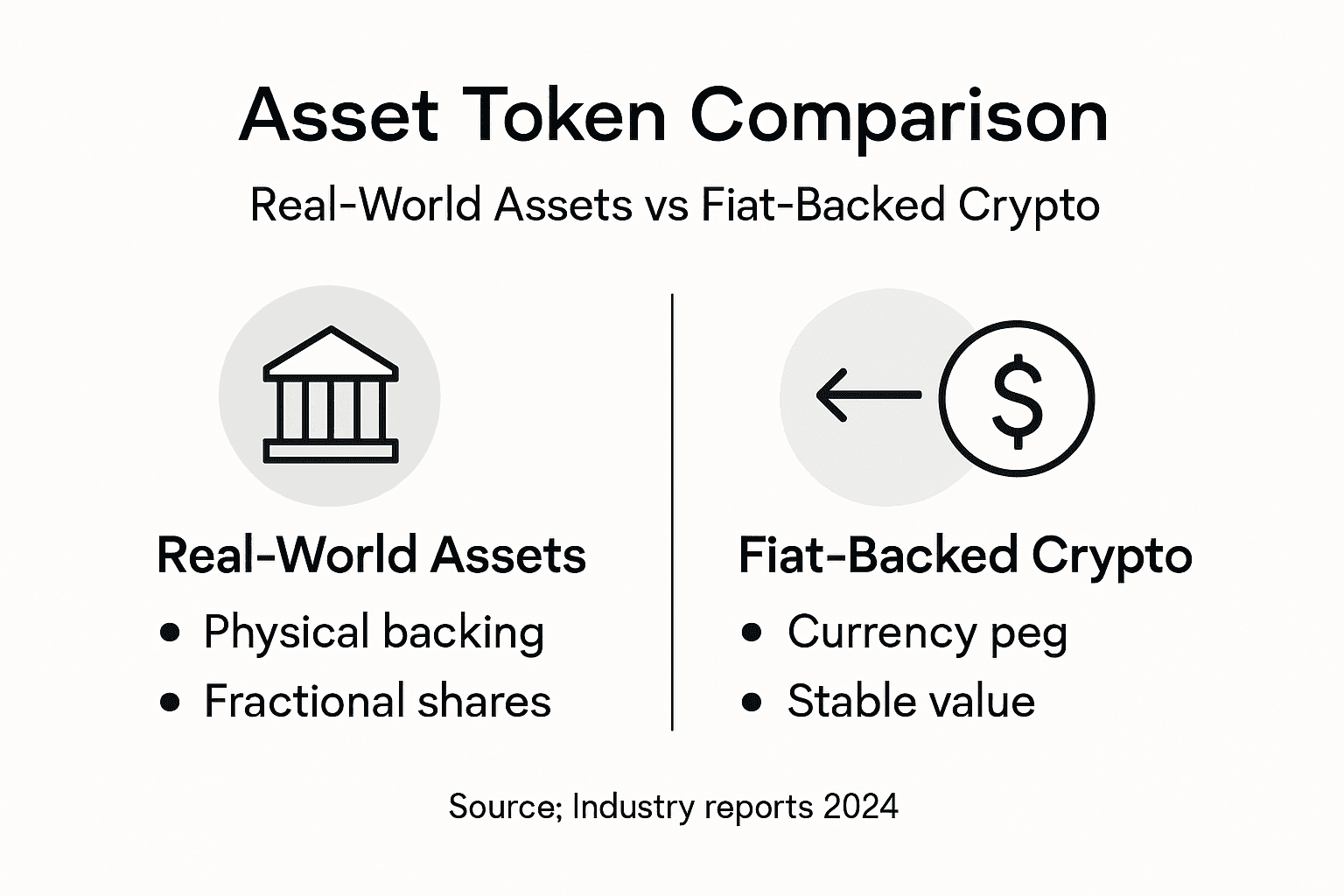
The primary distinction between these two approaches lies in their underlying value proposition. Real-world asset tokens offer direct ownership and transparency, while fiat-backed cryptocurrencies provide price stability through traditional currency reserves. Investors must carefully evaluate the specific backing, governance, and regulatory compliance of each instrument.
Here’s a side-by-side comparison of real-world asset tokens and fiat-backed cryptocurrencies:
| Attribute | Real-World Asset Tokens | Fiat-Backed Cryptocurrencies |
|---|---|---|
| Value Backing | Physical assets like gold, real estate | National currencies like USD or EUR |
| Price Stability | Linked to asset market fluctuations | Pegged 1-to-1 to fiat currency |
| Ownership Claim | Direct, verifiable asset claim | No direct claim on fiat, only redemption right |
| Audit/Transparency Needs | Physical reserve audits essential | Regular reserve disclosure required |
| Main Risks | Asset location, legal enforcement | Bank solvency, regulatory action |
| Investor Use Case | Diversification, store of value | Payments, trading pairs, hedging |
Pro tip: Always verify the actual asset reserves and audit documentation before investing in any asset-backed digital token to ensure transparency and reduce potential financial risks.
Types of Asset-Backed Tokens Explained
The world of asset-backed tokens is rapidly expanding, offering investors diverse opportunities to bridge traditional financial markets with blockchain technology. Global token categories represent a sophisticated approach to digitizing various asset classes, creating innovative investment mechanisms that transform how we perceive financial instruments.

Commodity-backed tokens form one critical category, with precious metals like gold and silver being prominent examples. These tokens provide direct digital ownership of physical assets, allowing investors to own fractional shares of tangible resources without the complexities of physical storage. Investors can now access real estate and commodity tokenization through blockchain platforms, democratizing access to traditionally illiquid investment classes.
Another significant category includes government and corporate securities tokens, which represent digitized bonds, treasury bills, and other financial instruments. These tokens offer enhanced liquidity, reduced transaction costs, and increased transparency compared to traditional trading mechanisms. Private credit tokens have also emerged, enabling direct investment in loan portfolios and credit instruments that were previously accessible only to institutional investors.
Fiat-currency backed tokens, or stablecoins, represent a unique subset designed to maintain consistent value by being pegged to traditional currencies like the US Dollar. These tokens provide stability in the volatile cryptocurrency market, serving as a critical bridge between digital and traditional financial ecosystems. Each token type serves distinct investor needs, from speculation and hedging to long-term wealth preservation.
Below is a summary of common asset-backed token types and their essential features:
| Token Type | Example Assets | Key Benefits | Typical Investor Goal |
|---|---|---|---|
| Commodity-Backed | Gold, silver, oil | Fractional ownership | Inflation hedge |
| Securities-Backed | Bonds, T-bills | Higher liquidity | Yield or income focus |
| Private Credit | Loan portfolios | Portfolio access | Income diversification |
| Fiat-Backed | USD, EUR stablecoins | Price stability | Trade, payments, hedging |
Pro tip: Carefully evaluate the specific collateralization ratio, transparency of reserves, and regulatory compliance before investing in any asset-backed token to ensure robust financial protection.
Tokenization Process and Reserve Proofs
Tokenization represents a sophisticated mechanism for transforming physical assets into digital representations, creating a bridge between traditional financial systems and blockchain technology. Blockchain ownership mechanisms enable investors to establish legally enforceable digital claims on real-world assets, revolutionizing how we conceptualize ownership and value transfer.
The tokenization process involves several critical steps designed to ensure transparency and legal integrity. Initially, asset owners must conduct comprehensive valuations and establish clear legal frameworks that define ownership rights. Digital asset verification protocols then create cryptographically secure representations of these assets, generating tokens with precise tracking mechanisms that document ownership, transfer, and fractional participation.
Reserve proofs play a crucial role in maintaining investor confidence by demonstrating the actual backing of digital tokens. These cryptographic mechanisms require token issuers to provide regular, verifiable documentation proving that each digital token corresponds to a specific quantity of physical assets. This process involves periodic audits, real-time tracking systems, and transparent reporting mechanisms that allow investors to validate the intrinsic value of their digital holdings at any moment.
The technical infrastructure supporting tokenization includes smart contracts, blockchain ledgers, and decentralized verification systems that automate compliance and reduce intermediary risks. These technologies enable instantaneous asset verification, fractional ownership capabilities, and global accessibility, transforming how investors interact with traditionally illiquid asset classes.
Pro tip: Always request and independently verify the reserve documentation and audit trails before investing in any asset-backed token to ensure complete transparency and mitigate potential financial risks.
Benefits and Use Cases for Investors
Real-world asset tokenization represents a transformative approach to investment, offering unprecedented opportunities for diversification and financial innovation. Global investment strategies demonstrate how tokenization can dramatically expand investor access to traditionally illiquid and complex asset classes, breaking down previous financial barriers.
Investors gain significant advantages through fractional ownership, which enables participation in high-value assets previously out of reach. Real estate investments, for instance, can now be divided into smaller, more accessible tokens, allowing individuals to own portions of commercial properties, luxury real estate, or international development projects. Investor market efficiency improves as these digital representations reduce transaction costs, eliminate geographical restrictions, and provide instant liquidity compared to traditional investment mechanisms.
The use cases for tokenized assets extend across multiple sectors, including commodities, private credit, and fixed-income instruments. Investors can now build more sophisticated, globally diversified portfolios with reduced minimum investment thresholds. Agricultural lands, precious metal reserves, infrastructure projects, and corporate debt can be tokenized, creating new pathways for portfolio construction that were previously unavailable to retail investors.
Additionally, blockchain-based tokenization introduces enhanced transparency and real-time settlement capabilities. Investors benefit from immediate transaction processing, reduced intermediary costs, and cryptographically secured ownership records. These technological innovations fundamentally reshape investment accessibility, allowing individuals to engage with complex financial instruments more efficiently and with greater confidence.
Pro tip: Carefully analyze the underlying asset quality, token liquidity, and regulatory compliance before making any tokenized asset investments to ensure robust financial protection.
Risks, Regulatory Oversight, and Comparisons
The landscape of asset-backed tokens involves complex regulatory challenges and inherent risks that investors must carefully navigate. Systemic financial risks reveal potential vulnerabilities in current tokenization frameworks, highlighting the need for robust regulatory mechanisms and comprehensive investor protection strategies.
Tokenized assets face multiple risk categories, including operational, legal, and counterparty risks. Asset tokenization compliance requires meticulous attention to legal enforceability, transparency, and regulatory alignment. Investors must assess risks such as potential oracle manipulation, custody challenges, and the reliability of underlying asset valuations. These risks differ significantly between fully collateralized tokens and those with fractional reserve mechanisms, demanding thorough due diligence.
Regulatory oversight varies dramatically across global jurisdictions, creating a complex landscape for asset-backed tokens. Some regions have implemented stringent frameworks requiring comprehensive asset verification, while others maintain minimal regulatory guidelines. This inconsistency introduces additional complexity for investors seeking to understand compliance requirements and potential legal protections. Financial authorities increasingly recognize the need for standardized regulations that balance innovation with investor safety.
Comparative analysis reveals that real-world asset tokens often provide more stability and transparency compared to traditional cryptocurrency instruments. Unlike purely speculative digital assets, tokens backed by tangible resources offer a more grounded value proposition. However, investors must remain vigilant about the specific mechanisms of asset backing, verification processes, and the financial health of token issuers.
Pro tip: Conduct comprehensive cross-jurisdictional research and consult financial experts to understand the specific regulatory environment surrounding any asset-backed token before making investment decisions.
Discover Transparent and Stable Asset-Backed Digital Investments
Navigating the complexities of real-world asset tokens versus fiat-backed cryptocurrencies can be challenging. Investors often worry about transparency, asset verification, and price stability while wanting a reliable way to secure value through digital assets linked to tangible resources. This article highlights the critical importance of verifiable ownership claims, reserve proofs, and understanding the backing mechanisms behind tokens to avoid common risks such as regulatory uncertainty and hidden counterparty risks.
At Maya Preferred, we address these pain points head-on by offering blockchain-based tokens backed by real gold and silver reserves, along with detailed proof documents, audits, and legal disclosures. Our tokens like MPRA, MPRD, and MCAT combine the trustworthiness of physical assets with the agility of digital finance. When you explore our platform at Maya Preferred, you gain access to a transparent ecosystem dedicated to long-term stability and clear regulatory compliance.
Don’t settle for unstable digital assets with unclear backing.
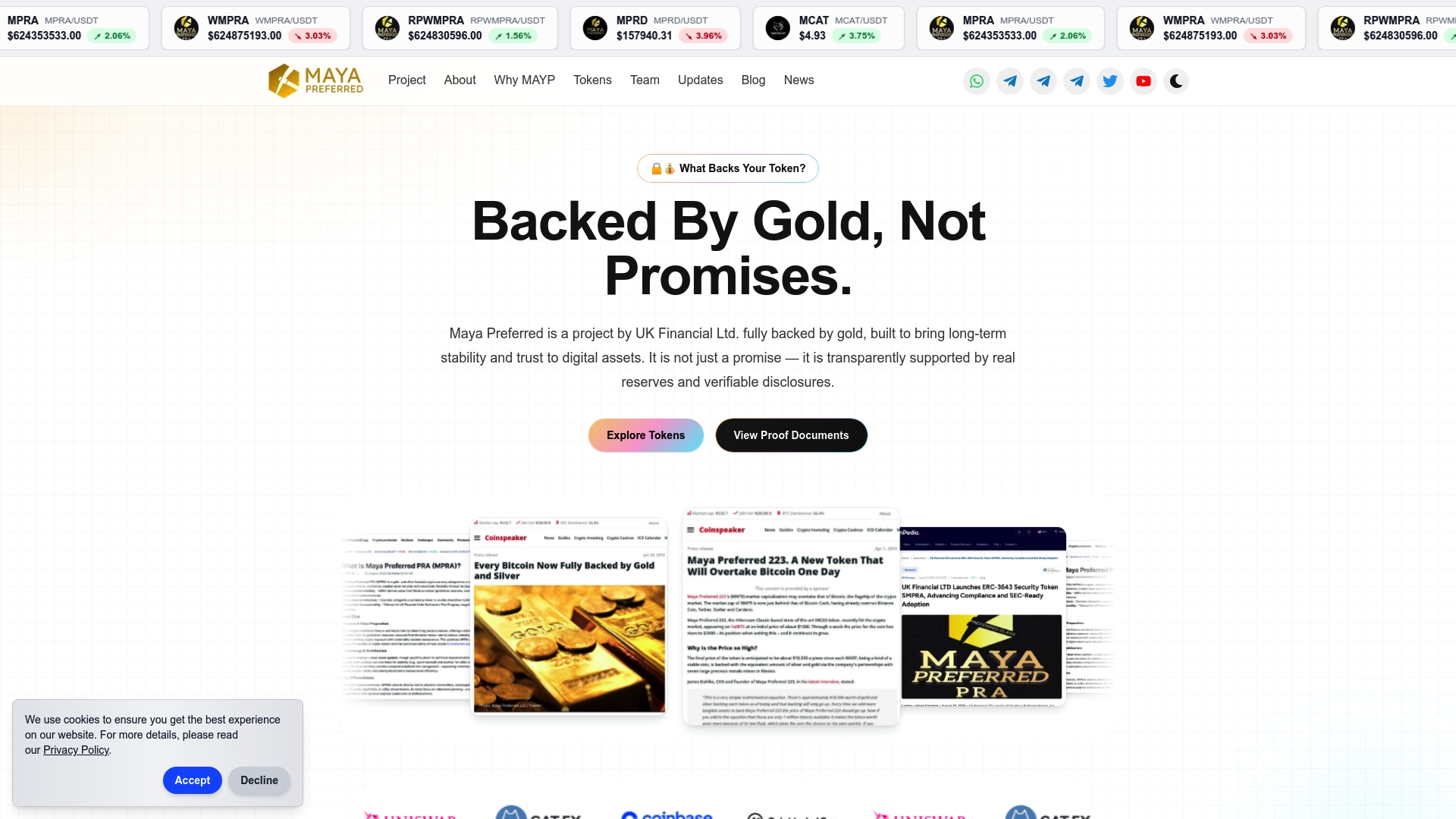
Take control of your investments today by choosing asset-backed digital tokens with trusted reserves. Visit Maya Preferred to discover how real gold and silver can anchor your portfolio in an evolving market. Learn more about our token offerings and join a growing community focused on transparency and lasting value.
Frequently Asked Questions
What are real-world assets in the context of digital finance?
Real-world assets refer to tangible or financial resources from the physical economy that are digitally represented on a blockchain, including precious metals, real estate, and commodities. They provide a stable investment mechanism by deriving value from underlying physical assets.
How do fiat-backed cryptocurrencies maintain their value?
Fiat-backed cryptocurrencies, also known as stablecoins, maintain their value by being pegged to traditional government-issued currencies like the US Dollar or Euro. Financial intermediaries hold reserve balances that are equivalent to the tokens in circulation to ensure price stability.
What are the main risks associated with investing in real-world asset tokens?
Investing in real-world asset tokens involves risks such as asset location, legal enforcement of ownership, and the accuracy of underlying asset valuations. It’s crucial to conduct thorough due diligence before investing in these tokens.
How does tokenization enhance investment accessibility?
Tokenization enhances investment accessibility by enabling fractional ownership of high-value assets, which allows more individuals to invest in previously inaccessible markets. It reduces transaction costs, eliminates geographical restrictions, and offers instant liquidity for investors.