
Token Utility Value: Why It Matters in Gold-Backed Crypto

Understanding what truly drives the value of an asset-backed token can be challenging for investors. For those focused on gold or silver-backed cryptocurrencies, the distinction between speculative hype and real, functional benefit is crucial. A token with genuine utility solves a real problem or enables a specific function within its platform, giving holders more than a promise of price gains. This article clarifies how utility value works in crypto, helping you identify tokens that offer both tangible benefits and commodity-backed security.
Table of Contents
- Defining Token Utility Value In Crypto
- Types Of Token Utilities And Key Differences
- How Token Utility Drives Asset-Backed Projects
- Risks, Pitfalls, And Investor Protections
- Comparing Utility Value To Alternative Tokens
Key Takeaways
| Point | Details |
|---|---|
| Token Utility Value | Token utility value refers to the functional benefits provided by a cryptocurrency within its ecosystem, distinguishing it from speculative assets. |
| Types of Tokens | Major token categories include utility tokens, security tokens, stablecoins, and gold-backed tokens, each serving unique purposes and possessing different risk profiles. |
| Investor Protection Risks | Regulatory ambiguity and technological vulnerabilities pose significant risks for investors in token projects, especially those backed by physical assets like gold. |
| Evaluating Project Viability | When assessing tokens, focus on transaction volume and active user engagement rather than just price metrics to gauge genuine utility adoption. |
Defining Token Utility Value in Crypto
Token utility value represents the actual, functional value that a cryptocurrency token provides within its ecosystem. Unlike speculative assets that derive value primarily from market demand, a token with genuine utility solves a real problem or enables a specific function. A digital token is fundamentally a unit of value existing in digital form on a blockchain or distributed ledger, but what distinguishes truly valuable tokens is their purpose. When you hold a utility token, you’re not just betting on price appreciation. You’re gaining access to something tangible: services, governance rights, economic participation, or operational capabilities within the platform that issued the token.
The relationship between a token and its utility directly impacts how investors should evaluate it. Token utility value in crypto relates to how tokens function within a blockchain ecosystem, underpinning their value through actual demand for the platform’s services. Consider the difference between three categories of tokens. Utility tokens provide access rights to services or governance participation. Cryptocurrencies function as mediums of exchange, facilitating transactions. Asset-backed tokens derive value from real-world assets like gold or silver reserves. For investors focused on gold-backed cryptocurrencies, understanding this distinction matters because asset-backed tokens combine the stability of physical commodities with the functionality of utility tokens, creating a hybrid value proposition that addresses both investment security and operational utility.
What makes token utility truly valuable is how it connects supply, demand, and actual usage. If a token grants you voting rights in governance decisions, reduces transaction fees on a platform, or provides rewards through staking, its utility creates genuine reasons to hold or use it beyond speculation. Token utility arises from the token’s function within decentralized finance projects, where tokens provide access rights to services, governance participation, or economic returns. The strength of this utility depends entirely on whether people actually need and use these functions. A token with exceptional utility in an ecosystem nobody uses remains worthless. Conversely, a token embedded in a platform with strong adoption and clear use cases attracts sustained demand regardless of short term price fluctuations. For investors evaluating gold-backed tokens specifically, this means assessing not just the physical reserves backing the token, but also what operational utility the token provides within the platform’s ecosystem. Does it grant access to trading, staking, or governance? Does it offer discounted fees or priority access to certain services? These functional aspects create layers of value that enhance the token’s investment appeal beyond its commodity backing.
Pro tip: When evaluating any token, separate its utility value from its speculative value by asking two questions: What specific problem does this token solve, and would the platform lose significant functionality if the token disappeared? Tokens that fail this test may offer entertainment value but rarely provide reliable investment foundations.
Types of Token Utilities and Key Differences
Token utilities come in distinct flavors, each serving a different purpose within their respective ecosystems. Understanding these categories helps you distinguish between tokens that actually deliver value and those relying primarily on hype. The major categories include payment tokens, access tokens, reward tokens, and governance tokens, each with specific functions that drive their utility within blockchain applications. Payment tokens reduce friction by allowing transaction fee payments directly within the platform, eliminating the need for traditional payment intermediaries. Access tokens grant holders the ability to use specific services or features within an ecosystem, creating a direct relationship between token ownership and platform functionality. Reward tokens incentivize network participation and user engagement, distributing value to contributors who help maintain or improve the ecosystem. Governance tokens represent perhaps the most sophisticated category, granting holders voting rights on critical decisions affecting the platform’s future direction and development.
The distinction between utility tokens and security tokens fundamentally changes how regulators treat them and what legal protections investors receive. Utility tokens grant holders access to platform services and functionalities, incentivizing network participation, whereas security tokens represent ownership stakes subject to regulation and investor protections. This matters enormously for your investment strategy. Utility tokens are evaluated based on their actual functionality and adoption rates within their ecosystems. If a platform attracts thousands of active users relying on its token for daily transactions or governance, the token has established genuine utility. Security tokens, by contrast, derive value from ownership claims on assets or future profits, placing them in regulated territory with stricter compliance requirements. For investors evaluating gold-backed cryptocurrencies, this distinction becomes particularly relevant. A token that combines gold-backed security with genuine utility functions operates in a unique space. It provides the stability and regulatory clarity of asset backing while simultaneously offering functional value within the platform’s ecosystem.
Within gold-backed token environments, the utility layer becomes especially important because it prevents the token from being a static store of value. Consider a platform that issues a gold-backed token with embedded utility for trading, staking, or governance. The gold backing provides a price floor and reduces volatility, while the utility functions drive actual demand and usage patterns independent of speculation. Payment utility allows holders to transact with reduced fees compared to alternative platforms. Access utility might grant priority trading hours, lower margin requirements, or exclusive access to certain trading pairs. Reward utility distributes a portion of platform fees to token holders or incentivizes them to provide liquidity. Governance utility empowers holders to vote on fee structures, asset listings, or operational decisions. This layered approach creates what researchers call a “sticky” token that people use not just because they hope the price rises, but because the token actively performs functions they need.

The relationship between token type and investor protection varies significantly. Utility tokens operate within specific blockchain applications to provide services like transaction fee payments or platform governance rights, but lack the legal protections afforded to securities. This means utility token holders assume greater risk in exchange for potential functional benefits and price appreciation. When evaluating tokens, ask yourself three specific questions. First, what concrete problem does this token solve that couldn’t be solved through direct payment or alternative methods? Second, how many active users currently rely on this token for its primary function? Third, would the platform’s core operations collapse if the token disappeared? Tokens that fail these tests may have speculative appeal but lack foundational utility value. Gold-backed tokens that answer these questions decisively occupy a privileged position in your portfolio. They combine commodity stability with functional demand, creating multiple reasons to hold them beyond pure speculation.
Pro tip: When comparing tokens, focus on active monthly users and transaction volume rather than total holders or price appreciation, as these metrics reveal genuine utility adoption versus speculative interest.
How Token Utility Drives Asset-Backed Projects
Token utility in asset-backed projects operates as the engine that transforms physical commodities into liquid, tradeable digital assets. Without meaningful utility, a gold-backed token becomes nothing more than a digital certificate that mirrors the underlying asset’s value. With utility layered into the platform, the token becomes essential infrastructure that investors and traders actively use to access markets, manage positions, and participate in governance. This is where the real power emerges. Tokenization links crypto tokens to traditional reference assets, establishing legal ownership claims and facilitating trading and automated governance via smart contracts, which enhances transparency and increases market efficiency. When you hold a gold-backed token with embedded utility functions, you’re not just holding a digital representation of precious metal. You’re gaining access to a comprehensive ecosystem designed to maximize the value you can extract from that asset backing. The token utility creates network effects that benefit all holders. As more people adopt the platform and utilize its token-driven features, the ecosystem becomes more efficient, liquid, and valuable. Transaction costs decline. Trading speeds improve. Governance becomes more distributed and representative. These improvements ripple outward, attracting additional participants and further strengthening the asset-backed project’s competitive position.
Asset-backed token projects leverage utility to unlock liquidity that wouldn’t exist in traditional markets. Consider how fractional ownership works in practice. A single ounce of gold might be valued at USD 2,000 in today’s market, placing it beyond the reach of many retail investors. By tokenizing that gold and dividing ownership into smaller units, a platform suddenly opens participation to investors with far smaller capital amounts. But fractional ownership alone doesn’t drive adoption. Token utility creates reasons to actively trade these fractional units. Payment utility allows holders to transact within the platform’s ecosystem without converting back to fiat currency. Staking utility rewards users who lock tokens for extended periods, incentivizing long-term holding and providing the project with operational stability. Asset-backed token projects use token utility to create digital representations of physical and financial assets, enabling fractional ownership, programmability, and interoperability across markets. This programmability is profound. Smart contracts can automatically execute transactions, rebalance portfolios, or trigger governance votes without manual intervention. Interoperability means tokens issued on one blockchain can potentially interact with services on other chains, dramatically expanding their utility universe. For gold-backed projects specifically, this means a holder could potentially use their gold-backed token as collateral for loans, trade it across multiple exchanges, stake it in liquidity pools, or vote on reserve management decisions, all without selling the underlying asset.
This table outlines the practical impacts of utility functions for gold-backed tokens:
| Utility Function | Business Impact | User Benefit |
|---|---|---|
| Payment | Enables low-fee transactions | Cost savings, faster trades |
| Staking | Increases platform liquidity and stability | Earn passive rewards |
| Governance | Decentralizes operational decisions | Voting power, platform input |
| Collateral | Expands use in DeFi lending | Borrowing without asset sale |
The relationship between token utility and project success follows a measurable pattern. Projects that fail to establish genuine utility typically experience price volatility disconnected from underlying asset performance. They attract speculators rather than users. Transaction volumes remain artificially low. Governance participation slumbers. Conversely, projects that successfully integrate utility functions see sustained demand independent of market cycles. Users interact with tokens daily because the platform delivers real value. This behavioral difference compounds over time. A utility-driven asset-backed project accumulates genuine users and transaction history, creating a credible foundation for long-term stability. Transparency improves because every transaction leaves a permanent record on the blockchain, allowing investors to verify both the asset backing and actual usage patterns. This dual verification is critical for asset-backed projects. You can independently confirm that the gold reserves exist through blockchain audits and traditional audits, while simultaneously observing whether traders and investors actually use the token’s utility features. This combination of transparency layers creates confidence that traditional investment vehicles simply cannot match.
Building utility within gold-backed projects requires thoughtful design choices. Too much complexity frightens away casual investors. Too little utility provides no compelling reason to use the token over alternatives. The most successful platforms balance accessibility with sophistication, offering basic payment and trading functionality for retail users while providing advanced features like margin trading, derivatives, or governance participation for sophisticated investors. Consider also how utility evolves with the project. Early-stage projects might focus on core payment utility and basic governance. As adoption grows and the project matures, additional utility layers emerge. Perhaps lending protocols get introduced, allowing holders to earn yield. Maybe cross-chain bridges launch, enabling holders to move tokens between ecosystems. These evolutionary utility expansions keep the platform relevant and provide ongoing reasons for participants to maintain holdings and engagement. The projects that thrive long-term are those that view utility as an ongoing development priority rather than a one-time feature set.
Pro tip: When evaluating gold-backed token projects, examine transaction volume and active user counts relative to total supply held, since these metrics reveal whether the token utility is genuinely driving adoption or if holders are primarily speculating on asset price appreciation.
Risks, Pitfalls, and Investor Protections
Investing in token-based projects, even those backed by tangible assets like gold, exposes you to risks that traditional investment vehicles do not. Regulatory ambiguity creates the first major vulnerability. Governments worldwide have yet to establish consistent frameworks for utility tokens and asset-backed cryptocurrencies. What regulators classify as a security in one jurisdiction might be treated as a commodity in another. This uncertainty cascades into practical problems. A project that operates smoothly today could face legal challenges tomorrow if regulators decide tokens qualify as unregistered securities. The regulatory ambiguity surrounding utility tokens exposes investors to risks such as lack of transparency, speculative volatility, and potential fraud. This matters directly to your portfolio. Without clear regulatory oversight, investor protections vary dramatically. Some platforms implement robust disclosure requirements and security audits. Others operate with minimal transparency. Your responsibility as an investor is to identify which category a project falls into before committing capital. Even gold-backed projects face this uncertainty. The fact that gold reserves exist does not automatically protect you if the platform itself becomes embroiled in regulatory disputes or security failures that freeze withdrawals or prevent token trading.
Technological vulnerabilities present the second critical risk category. Smart contract flaws can destroy projects overnight. A single coding error in the automated systems managing token functions, governance, or reserve interactions could enable theft, unlock unintended token minting, or crash the entire platform. Utility tokens face risks including regulatory uncertainty, technological vulnerabilities like smart contract flaws, price volatility, token misuse, and liquidity constraints. These vulnerabilities matter because even professional developers occasionally miss critical security issues. Projects that have undergone third-party smart contract audits provide higher confidence, but audits are not perfect. They represent a snapshot in time and may not catch all vulnerabilities, particularly in complex systems. Additionally, tokens operate on blockchains that themselves can experience security issues or be subject to attacks. If the underlying blockchain becomes compromised, token security deteriorates regardless of how well the project’s own code is written. This interdependency means you cannot evaluate token risk in isolation. You must assess both the project’s security measures and the security of the blockchain infrastructure supporting it.
Price volatility and liquidity constraints pose interconnected financial risks. Gold-backed tokens should theoretically experience less volatility than pure cryptocurrency speculation plays, but reality proves messier. If few people trade the token, acquiring or liquidating meaningful positions becomes difficult without moving prices sharply. This liquidity constraint creates a trap where your token value might be perfectly sound theoretically, but you cannot actually sell significant holdings without accepting substantial discounts. Meanwhile, speculative demand or supply shocks can cause price movements disconnected from underlying asset value. Token misuse also occurs when projects operate with insufficient reserves or allocate reserve assets to undisclosed purposes. This is why examining proof of reserves matters. Independent verification that stated gold backing actually exists in secure storage, held by reputable custodians, and properly accounted for protects you against the most devastating failure mode: discovering your token is backed by nothing.
Practical Protection Strategies
Differentiating between projects with genuine investor protections and those relying on faith requires systematic evaluation:
-
Verify reserve backing independently – Do not accept company claims about gold reserves. Look for third-party audits from recognized accounting firms or blockchain verification protocols that prove reserves actually exist.
-
Examine smart contract audit reports – Projects should publish detailed audit reports from reputable security firms. Read summaries of any identified vulnerabilities and how they were remediated.
-
Assess regulatory compliance – Determine which jurisdictions the project operates in and what regulatory frameworks apply. Projects transparent about their legal status carry lower regulatory risk.
-
Analyze token liquidity and trading volume – Check historical volume on exchanges and ensure sufficient trading activity exists to support your intended position size without price slippage.
-
Review governance participation – Can you actually vote on decisions affecting the project? Governance tokens that exist but grant no real influence provide the appearance of control without substance.
-
Monitor transaction records – For gold-backed projects, examine blockchain records showing actual token utility usage. Sustained transaction volume indicates real adoption rather than dormant speculation.
Pro tip: Before investing in any token project, allocate funds only after verifying independent reserve audits, reviewing smart contract security audits, and confirming you can liquidate your position quickly at reasonable prices during both normal and stressed market conditions.
Comparing Utility Value to Alternative Tokens
Token categories exist along a spectrum, each offering fundamentally different value propositions and risk profiles. Understanding where utility tokens sit relative to alternatives helps you make informed allocation decisions. Security tokens represent ownership stakes in companies or assets, functioning like traditional equity or debt instruments with corresponding regulatory protections and restrictions. Holders of security tokens receive legal ownership rights, potential dividend distributions, and voting powers on company matters. Stablecoins peg their value to external references like the US dollar or gold, trading within narrow price bands to facilitate transactions without volatility concerns. Non-fungible tokens represent unique digital or physical assets where each token is distinct and irreplaceable, commonly used for art, collectibles, or ownership verification. Utility tokens occupy a different category entirely. Utility tokens provide platform-specific services and access rather than ownership rights, contrasting sharply with security tokens that confer ownership stakes. Their value depends heavily on platform adoption and actual functionality. Investors in utility tokens do not own pieces of the company issuing the token. They own the right to use platform services, participate in governance, or earn rewards. This functional distinction drives dramatically different valuation mechanics and regulatory treatment.
For gold-backed tokens specifically, this comparison becomes nuanced. A gold-backed utility token combines attributes from multiple categories. It has security token characteristics through its physical commodity backing, providing stability and regulatory clarity unavailable to pure utility tokens. It has utility token characteristics through embedded functions like trading, staking, or governance participation. It can possess stablecoin characteristics if the platform pegs token value closely to gold prices, reducing volatility relative to pure cryptocurrency. This hybrid positioning offers advantages and tradeoffs. The advantage lies in combining multiple value sources. If the platform functions poorly and nobody uses the token’s utility features, the gold backing still anchors value and protects against total loss. If the platform thrives, utility adoption adds demand layers beyond commodity value. Conversely, the complexity introduces additional risks. Investors must evaluate both asset backing AND platform quality. A project with excellent gold reserves but terrible token utility may disappoint. Utility tokens serve as a medium of exchange within platforms exhibiting network effects, which contrasts with equity tokens that confer ownership stakes and their distinct economic dynamics. Pure utility token projects live or die based on network adoption. If nobody uses the platform, the token becomes worthless regardless of technological sophistication. Asset-backed tokens provide a safety net that pure utility tokens lack.
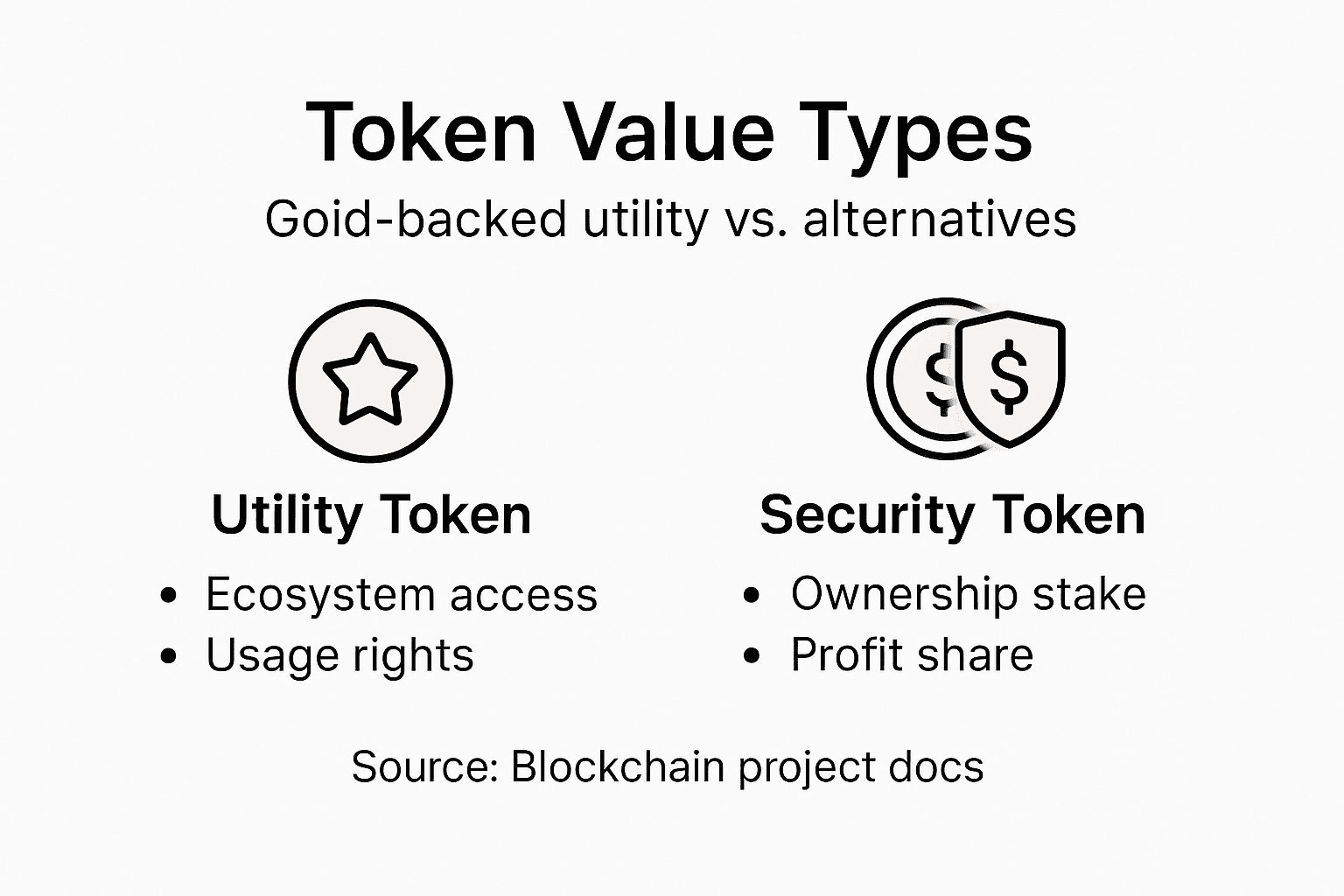
The performance comparison between utility tokens and alternatives reveals important patterns. Pure utility tokens in early-stage projects exhibit extreme volatility as market sentiment swings based on adoption progress. Successful utility token projects that build genuine network effects can eventually stabilize and appreciate substantially as network value compounds. Security tokens typically experience lower volatility but lower explosive upside potential, since their value derives from measurable asset ownership or earnings rather than speculative growth expectations. Stablecoins provide the lowest volatility but offer minimal investment returns beyond capital preservation. Gold-backed utility tokens theoretically position investors for balanced returns. The gold backing prevents catastrophic downside during pessimistic sentiment phases. Successful utility development provides upside capture during optimistic phases. This balanced risk-reward profile appeals particularly to conservative investors seeking cryptocurrency exposure without extreme volatility exposure.
Evaluation Framework
When comparing token categories, consider these critical dimensions:
Here’s a structured comparison of major token types in the crypto ecosystem:
| Token Type | Primary Value Source | Regulation Level | Typical Volatility |
|---|---|---|---|
| Utility Token | Platform functionality | Unclear, evolving | High to extreme |
| Security Token | Asset ownership, earnings claims | Heavily regulated | Low to moderate |
| Stablecoin | Peg to reference asset | Increasingly regulated | Very low |
| Gold-Backed Utility | Asset backing plus utility | Condition-dependent | Low to moderate |
Value Source
- Utility tokens: Platform adoption and functionality
- Security tokens: Asset ownership or earnings claims
- Stablecoins: Peg mechanism to reference asset
- Gold-backed utility tokens: Asset backing PLUS platform adoption
Regulatory Status
- Utility tokens: Unclear and evolving
- Security tokens: Heavily regulated with investor protections
- Stablecoins: Increasingly regulated with reserve requirements
- Gold-backed utility tokens: Depends on classification and compliance approach
Volatility Expectations
- Utility tokens: High to extreme
- Security tokens: Low to moderate
- Stablecoins: Very low
- Gold-backed utility tokens: Low to moderate
Downside Protection
- Utility tokens: Minimal
- Security tokens: Moderate through ownership claims
- Stablecoins: Strong through peg mechanisms
- Gold-backed utility tokens: Strong through asset backing
Gold-backed utility tokens occupy a privileged position in this framework. They offer downside protection comparable to security tokens through physical asset backing, while maintaining utility token upside potential through network effects. This dual positioning explains their appeal to sophisticated investors seeking exposure to cryptocurrency innovation while maintaining prudent risk management.
Pro tip: When choosing between utility tokens and gold-backed utility tokens, evaluate whether the platform’s utility functions actually create ongoing demand beyond initial token sale hype by examining transaction volumes, daily active users, and fee revenue metrics across at least twelve consecutive months.
Discover Real Utility and Transparency in Gold-Backed Crypto with Maya Preferred
Understanding token utility value is essential for investors who want more than speculation from their crypto assets. This article highlights the importance of genuine token utility supported by physical backing and transparent governance. Maya Preferred addresses these challenges head on by offering blockchain tokens like MPRA, MPRD, and MCAT that combine real gold and silver reserves with clear proof documents and robust audit disclosures. Our platform solves the critical issues of trust, liquidity, and regulatory clarity that many investors face when exploring asset-backed cryptocurrencies.
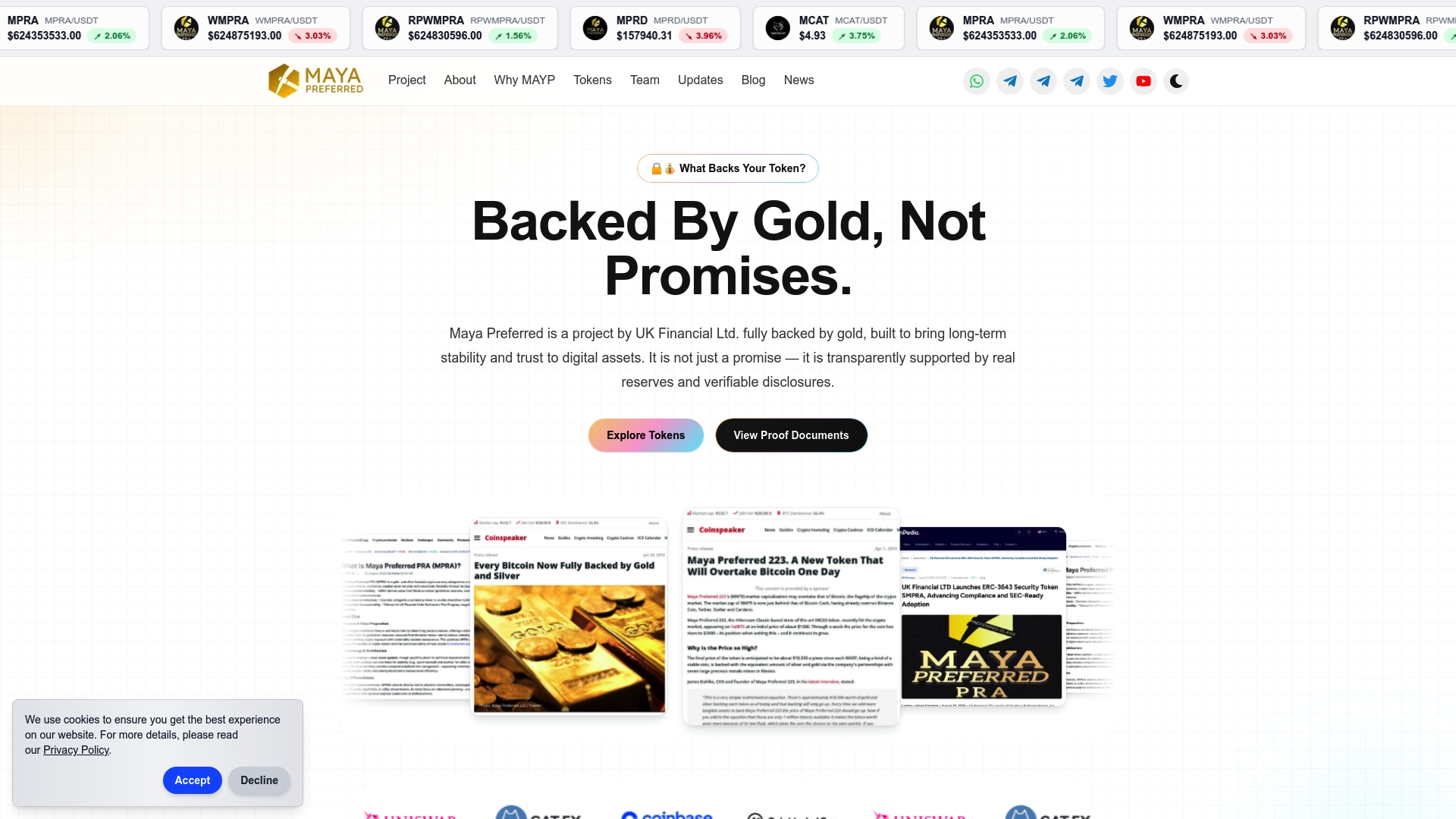
Take control of your crypto investments today by choosing tokens that deliver transparent asset backing alongside active platform utility. Visit Maya Preferred to explore how our ecosystem bridges traditional precious metals with innovative digital solutions. Access comprehensive reserve reports, trade securely, and engage with a thriving community dedicated to long-term stability and growth. Stay informed with regulatory updates and CEO insights specifically designed to empower your investment decisions.
Learn more about our tokens and their unique utilities at https://mayapreferred.io and start building a portfolio grounded in real value now.
Frequently Asked Questions
What is token utility value in gold-backed crypto?
Token utility value refers to the actual functional benefits a cryptocurrency token provides within its ecosystem, distinguishing valuable tokens from speculative ones. In the case of gold-backed crypto, this means the token is not only tied to the value of gold but also offers specific services, governance rights, or operational capabilities within its platform.
Why does token utility matter for investors?
Token utility is crucial for investors because it indicates the real demand for the token beyond mere speculation. A token with robust utility can enhance its value through actual use cases and active participation in a platform, helping maintain demand independently of market fluctuations.
How do different types of tokens, like utility and security tokens, differ?
Utility tokens provide access to services or features within a platform, while security tokens represent ownership stakes in assets and offer regulatory protections. Gold-backed utility tokens combine attributes of both, being secured by a physical commodity while also enabling functional use within their ecosystem, adding complexity and value.
What risks should investors consider with gold-backed utility tokens?
Investors should be aware of regulatory ambiguity, technological vulnerabilities, price volatility, and liquidity constraints. It is essential to verify the existence of gold reserves, assess the project’s regulatory compliance, and ensure that the token has sufficient trading volume to avoid problems when liquidating positions.