
Top Gold-Backed Cryptocurrencies – Expert Comparison 2026

Holding real assets used to mean heavy vaults and complex paperwork but new technology is changing how people access gold and stable value. With digital tokens tied to physical wealth, the line between traditional assets and modern finance gets thinner. Some projects promise you can own a piece of gold or silver through a blockchain and keep track of it as easily as sending a message. Others say you get reliable stability for moving money or protecting savings no matter where you are in the world. Each platform tries to solve old problems with a new approach and transparency. How do these solutions really compare when trust and tangibility matter most
Table of Contents
Maya Preferred
At a Glance
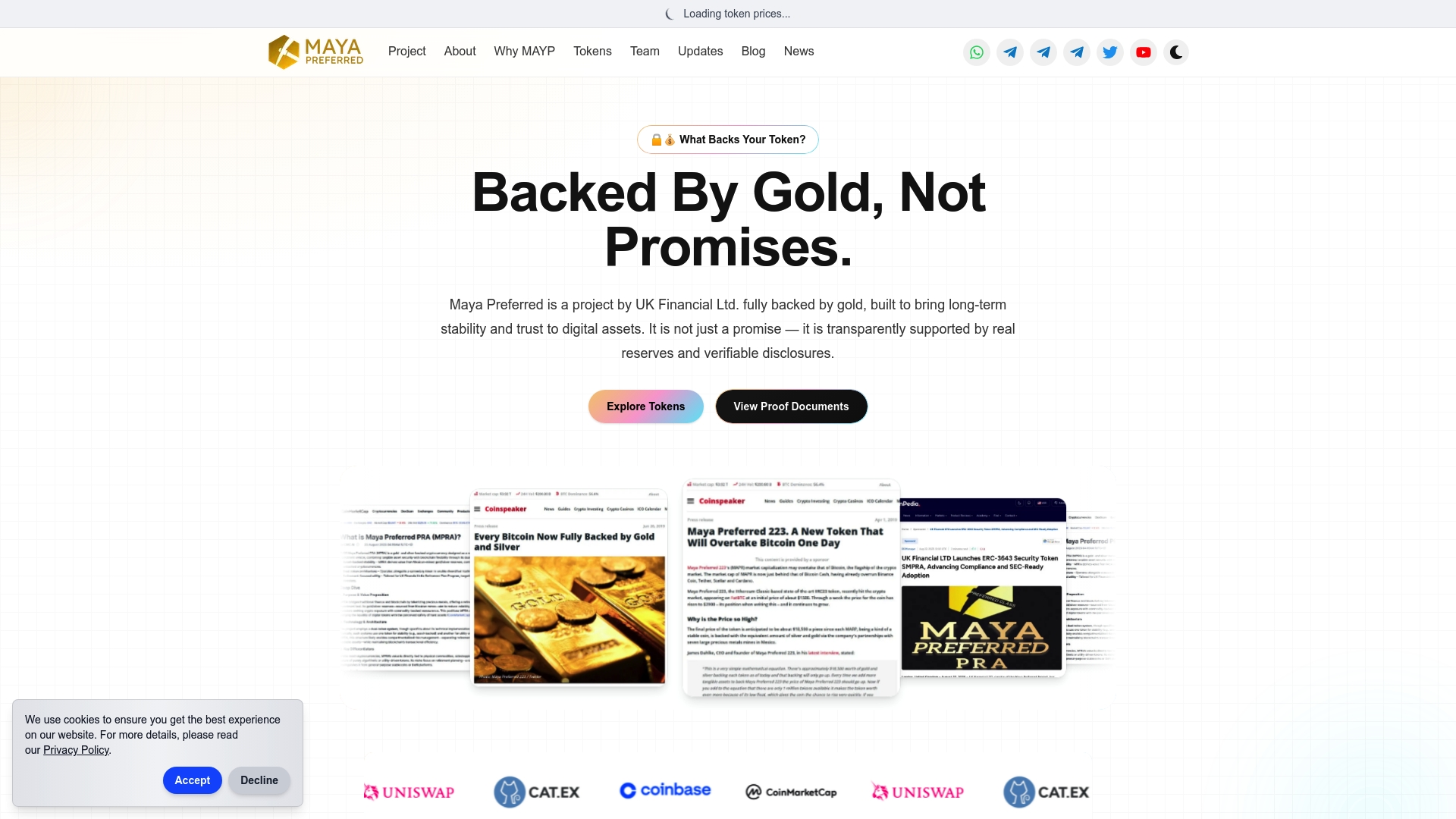
Maya Preferred is a blockchain project from UK Financial Ltd. that anchors digital tokens to physical gold and silver reserves, prioritizing transparency and auditability. Its dual-class token design (MPRA and MPRD) and published proof documents position it as a pragmatic bridge between traditional precious metals investing and modern crypto exposure. If you want asset-backed stability and regulatory-minded token design, Maya Preferred delivers a clear, verifiable option.
Core Features
Maya Preferred pairs real-world collateral with blockchain utility: tokens are fully backed by gold and silver reserves and supported by verifiable disclosures and third-party audits. The platform implements a dual-class token system—MPRA for SEC-compliant security token development and MPRD for broader utility—while integrating with EVM-compatible blockchain networks. Documentation on reserves, project locations, and legal filings is central to the site, and leadership provides ongoing news, CEO updates, and community engagement channels.
Pros
- Tangible asset backing: Tokens are fully backed by gold and silver reserves, giving holders direct exposure to physical collateral rather than purely speculative value.
- Transparent disclosures: The project publishes proof documents and third-party audits, allowing investors to verify reserves and legal compliance in detail.
- Regulatory focus: MPRA is positioned as a security token developed with SEC compliance in mind, which supports institutional-style adoption.
- Dual-token architecture: The MPRA and MPRD split stability and utility roles, creating an ecosystem designed for both compliance and practical use.
- Active community and leadership updates: Regular news, CEO communications, and engagement channels help sustain investor confidence and long-term visibility.
Who It’s For
Maya Preferred targets investors and stakeholders who want stable, asset-backed digital tokens with rigorous transparency and compliance features. It is especially relevant to mining stakeholders, wealth managers, and crypto traders seeking gold and silver exposure without the logistics of physical custody. If you prioritize provable reserves, audited disclosures, and a token architecture designed for regulatory pathways, this project fits your portfolio strategy.
Unique Value Proposition
Maya Preferred distinguishes itself by marrying audited, on-chain tokenization with explicit, published evidence of physical backing. Unlike tokens that claim asset backing without verifiable proof, Maya Preferred centralizes documentation—reserves, project locations, and legal filings—so you can independently confirm collateral. Its dual-class model separates compliance-grade security token development (MPRA) from utility token functions (MPRD), enabling both institutional trust and ecosystem growth. That combination reduces counterparty ambiguity and makes Maya Preferred a superior choice for investors who need tangible collateral, documented proof, and a roadmap toward regulated token use.
Real World Use Case
An investor seeking metal-backed crypto exposure can purchase MPRA on trading venues such as Catex.io to gain verified access to gold-backed value, then track published audits and reserve reports on Maya Preferred’s site to validate holdings. Mining partners and portfolio managers can also review legal filings and reserve documentation to assess long-term stability.
Pricing
Token prices are not specified on the site: “Loading token prices… (not specified, prices are available on trading platforms like Catex.io).” Expect to consult trading platforms for live market pricing and liquidity details.
Website: https://mayapreferred.io
Paxos Gold (PAXG)
At a Glance
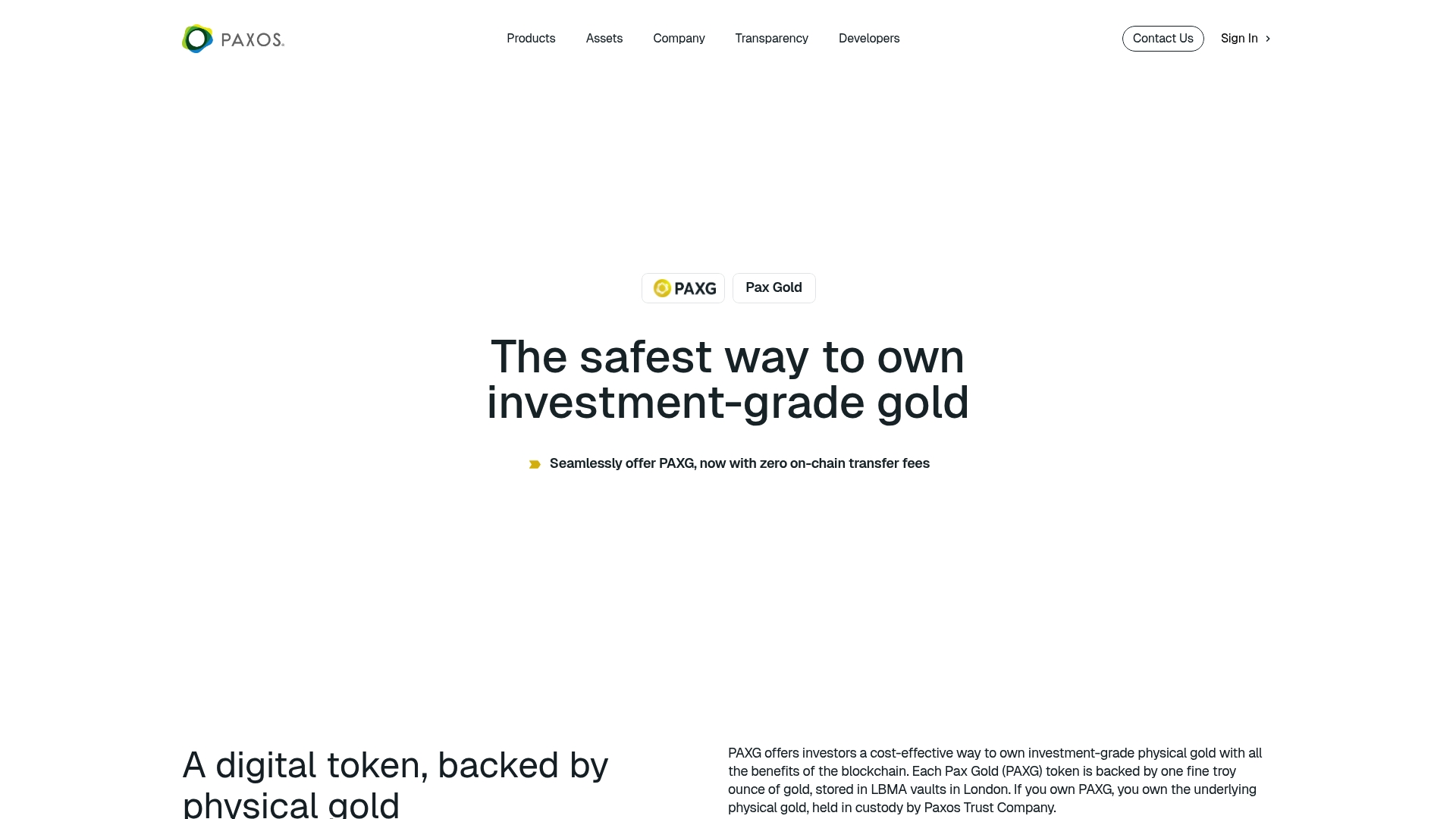
Paxos Gold (PAXG) tokenizes one fine troy ounce of LBMA-certified gold per token, giving investors blockchain access to physical gold stored in London vaults. It combines regulated custody by Paxos Trust Company with monthly attestations, near-instant settlement, and low friction trading on multiple exchanges. For investors who want transparent, redeemable gold exposure without the logistics of physical storage, PAXG delivers a clear, regulated pathway. Not perfect for everyone. Physical delivery and regional availability can introduce limits.
Core Features
PAXG maps a single token to one fine troy ounce of gold held in LBMA vaults in London, with ownership rights recorded and custody maintained by Paxos Trust Company. The token emphasizes cost efficiency versus traditional options, advertises no storage fees and a low minimum purchase amount, and is audited or attested monthly by Paxos Trust Company in the US. Built on blockchain rails, it offers near-instant settlement, transparent proof-of-reserve lookups, and broad distribution via multiple exchanges and platforms.
Pros
- Direct gold ownership on-chain: PAXG gives you legal ownership of physical gold via a digital token, letting you hold an asset-backed position without metal handling.
- Regulated custody and monthly attestations: Paxos Trust Company provides regulatory oversight and monthly reports that increase transparency and investor confidence.
- Cost-efficient access: The token aims to be cheaper than many alternative gold exposure methods by reducing storage and transaction overhead.
- Redemption flexibility: Holders can redeem PAXG for physical gold or fiat currency, providing an off-ramp that preserves the underlying asset linkage.
- Wide market access: PAXG is listed on multiple exchanges and platforms, improving liquidity and tradeability for traders and institutions.
Cons
- Physical delivery may be limited in practice: Although PAXG is redeemable, actual gold delivery can depend on platform rules, logistics, and jurisdictional constraints, which may restrict immediate metal retrieval.
- Fractional features vary by platform: Some benefits like fractional ownership or small-lot redemption rely on the exchange or wallet provider, not PAXG itself, creating inconsistent user experiences.
- Regional availability discrepancies: Access and trading options for PAXG may differ across countries, so investors could face regional restrictions or limited on-ramps.
Who It’s For
PAXG suits investors seeking regulated, auditable exposure to physical gold with the convenience and speed of blockchain settlement. You are likely a trader, asset manager, or mining stakeholder who values transparency, custody assurance, and the ability to move gold exposure across crypto rails quickly. If you need guaranteed immediate physical delivery in all scenarios, look carefully at platform terms first.
Unique Value Proposition
PAXG uniquely pairs LBMA-vaulted, investment-grade gold with regulated custody and blockchain liquidity, delivering a bridge between traditional precious metals and tokenized markets. That combination reduces settlement risk and simplifies transfers while preserving a redeemable link to the underlying metal.
Real World Use Case
An investor buys PAXG to hedge inflation, stores tokens in a self-custody wallet, and trades them on an exchange during market swings. If needed, the investor can redeem tokens for fiat or request physical gold delivery per Paxos procedures, turning a digital hedge into tangible metal.
Pricing
PAXG advertises a cost structure lower than many gold tokens and ETFs, but exact pricing follows live gold market rates and transaction size, so final costs vary per trade and platform.
Website: https://paxos.com/pax-gold
Tether Gold
At a Glance
Tether Gold is a blockchain token pegged 1-to-1 with physical gold, designed to let you own and transfer gold digitally across multiple chains. It blends traditional commodity backing with the convenience of digital transfers, supported by regular reserve disclosures. For investors seeking a direct gold exposure in token form, it presents a transparent, accessible option — but it still depends on the issuing entity’s ongoing disclosures and reserve integrity.
Core Features
Tether Gold provides a digital representation of physical gold that is pegged one-to-one with allocated gold holdings. It is issued on multiple blockchains, including Ethereum and Algorand, enabling wider accessibility and interoperability. The token is fully backed by physical gold reserves and designed to enable ownership transfer without moving the metal itself. The project publishes regular transparency reports on reserves so holders can verify backing and audit traces.
Pros
- Digital access to physical gold: It offers a straightforward way to hold gold exposure without storing metal, simplifying custody for investors.
- Multi-chain availability: Being on Ethereum, Algorand, and other chains increases accessibility for traders and platforms across different ecosystems.
- Fully backed reserves: The token is described as fully backed by physical gold, which provides a clear linkage between the digital token and a tangible asset.
- Regular transparency reports: Periodic disclosures on reserves help users verify the backing and reduce information asymmetry.
- Facilitates commodity-backed digital finance: It supports use cases where a gold-backed digital instrument expands payment, collateral, and diversification options.
Cons
- Dependent on issuer transparency and backing: The token’s value and trust rest on the issuing entity’s continued accuracy and honesty in reporting reserves.
- Potentially lower liquidity than pure crypto: Gold-backed assets can trade with less volatility and potentially less liquidity compared to native cryptocurrencies, which may affect exit speed.
- Multi-chain complexity can confuse users: Supporting several blockchains introduces differing transfer protocols and wallet requirements that may frustrate less technical users.
Who It’s For
Tether Gold fits investors who want direct gold exposure without physical custody, traders seeking portfolio diversification or hedging tools, and businesses that require gold-backed collateral or payment rails. If you manage a fund, run cross-border payments, or need a commodity-backed digital instrument, this token can integrate into those workflows with fewer logistical hurdles than moving bullion.
Unique Value Proposition
Tether Gold’s core distinction is offering a 1-to-1 gold-pegged digital token that combines physical backing with blockchain transferability and multi-chain reach. Its blend of tangible reserve backing plus periodic transparency reports aims to bridge the trust gap between bullion and digital assets, enabling practical use of gold in modern blockchain-based finance.
Real World Use Case
A fintech platform can integrate Tether Gold to let customers buy and hold gold via tokenized balances, enabling seamless international transfers and portfolio diversification without shipping metal. The platform relies on the token’s reserve disclosures to reassure users while reducing custody and settlement friction.
Pricing
The price of Tether Gold (XAUT) moves with the market price of physical gold and is available on live market data panels for real-time valuation.
Website: https://tether.to/en/gold
Paxos
At a Glance
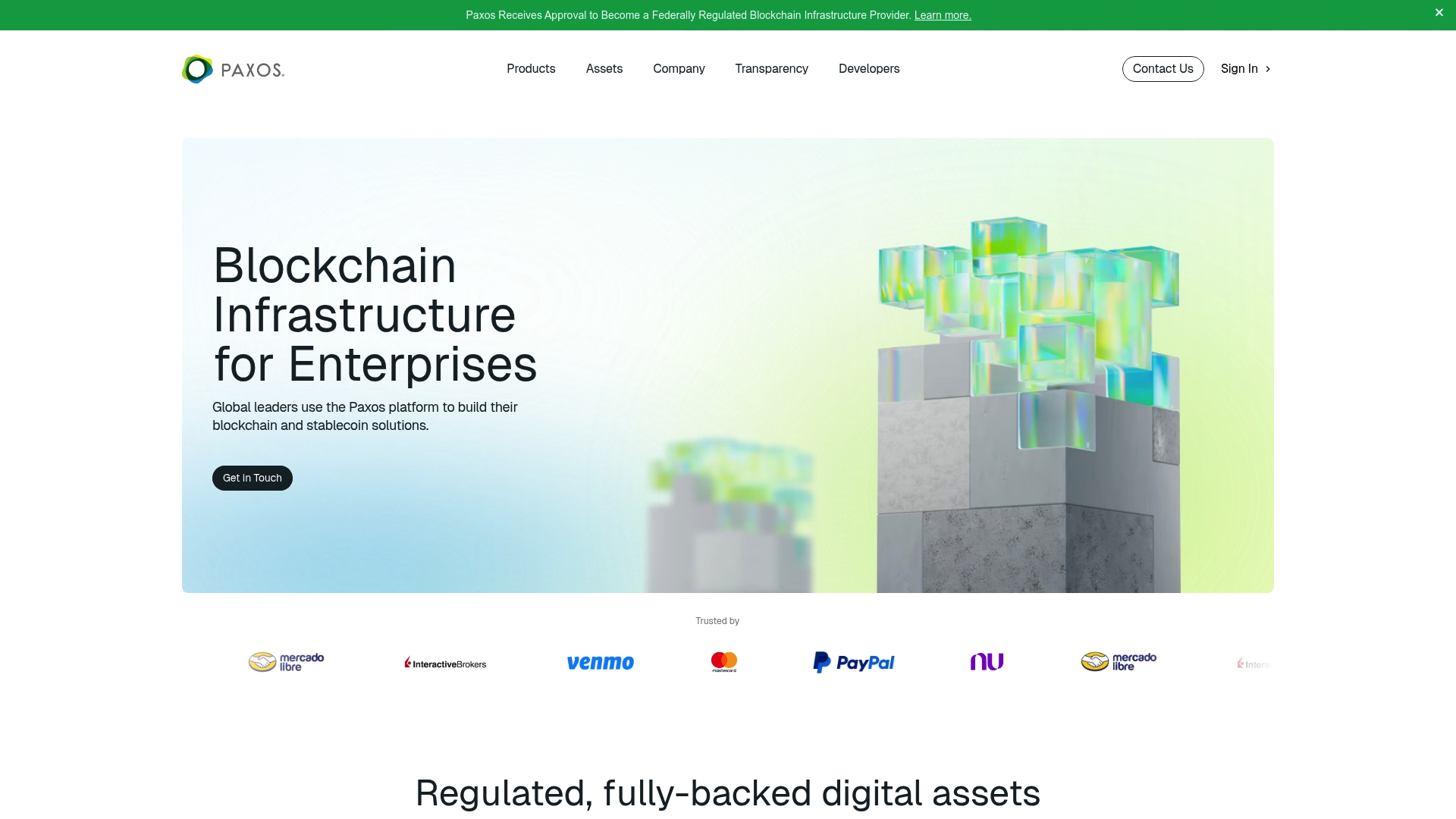
Paxos offers regulated blockchain infrastructure aimed squarely at enterprises that need trustworthy, asset-backed digital solutions. The platform issues stablecoins and tokens backed by USD and gold while emphasizing transparency and regulatory compliance. For organizations that prioritize auditability and institutional-grade partners, Paxos is a strong contender; however, specific product limits and pricing are not detailed in the available content. Consider it a compliance-first provider with trade-offs around complexity.
Core Features
Paxos delivers regulated blockchain infrastructure products for enterprises and issues digital assets backed by real assets such as USD and gold. Its stablecoin and token lineup includes USDP, USDG, PAYUSD, and PAXG, and the platform supports crypto brokerage, wallet infrastructure, payments solutions, and a global dollar network for acceptance and payouts. Paxos also collaborates with large commercial partners to build mainstream crypto products, and it operates inside a global, regulated framework designed to prioritize trust and transparency.
Clear trade-offs.
Pros
- Regulatory oversight and compliance: Paxos operates under multiple regulatory authorities, which gives institutions clearer guardrails for custody, issuance, and operations.
- Backed by real assets for stability: The platform issues tokens and stablecoins with asset backing in USD and gold, which supports a predictable peg and better trustee accountability.
- Partnerships with established companies: Collaborations, including work with PayPal, demonstrate Paxos ability to integrate with mainstream payment and fintech ecosystems.
- Diverse product range: Paxos provides several stablecoins and token types, plus brokerage, wallet, and payments infrastructure that address multiple enterprise needs.
- Focus on transparency and trust: Public emphasis on audits, regulatory compliance, and asset backing aims to reduce counterparty risk for institutional users.
Cons
- Limited product detail in source content: The available information does not specify granular product constraints, limits, or feature-level behaviors that matter to implementers.
- Complex regulatory environment: Operating across multiple jurisdictions creates operational complexity that can slow integrations or require intensive legal review.
- Dependence on regulatory developments: Paxos model relies on continued regulatory clarity and approvals, which introduces external risk to roadmaps and product availability.
Who It’s For
Paxos is built for enterprises, developers, financial institutions, and fintech firms that require regulated, asset-backed digital currency solutions. If your organization needs compliant stablecoins, custodial clarity, and enterprise-grade payments rails, Paxos aligns with those priorities. You should be prepared for governance and compliance work, though—this is not a plug-and-play retail token.
Unique Value Proposition
Paxos unique value lies in combining enterprise-oriented blockchain infrastructure with asset-backed tokens and active regulatory oversight. That blend positions Paxos as a partner for institutions seeking to move fiat-like assets onto distributed ledgers while keeping legal and auditability requirements front and center.
Real World Use Case
A multinational company uses Paxos to issue a USD-linked stablecoin for cross-border payroll and supplier payouts, enabling faster settlement and improved liquidity management while maintaining regulatory compliance and asset backing.
Pricing
Pricing is not specified in the provided content; enterprise pricing and contract terms are likely available through direct engagement with Paxos sales and partnerships teams.
Website: https://paxos.com
Tether
At a Glance
Tether is the most widely adopted stablecoin family, designed to provide a digital fiat peg across multiple blockchains. Its tokens are backed by reserves and claim daily transparency on reserves and circulation. For traders and businesses that need a low-volatility digital medium, Tether delivers high liquidity and broad exchange support. But its reliance on centralized reserve management and ongoing regulatory scrutiny remain notable caveats.
Core Features
Tether issues tokens across blockchains including Ethereum, Tron, and Solana, and maintains 1:1 pegs to fiat currencies such as USD, MXN, CNH, and even commodity pegs like Gold. The project emphasizes that each token is fully backed by reserves composed of traditional currency and other assets, and it provides daily updates on reserves and circulation. That multi-chain, multi-currency approach makes Tether a plumbing layer for trading, payments, and liquidity provision inside crypto markets.
Stop. Consider the tradeoffs.
Pros
- Widely adopted across major exchanges: Tether’s market presence makes it easy to enter and exit positions on most trading platforms.
- High liquidity and trading volume: Large daily volumes reduce slippage for sizable trades and make it practical for arbitrage strategies.
- Fully collateralized with reserve disclosures: The token family is backed by reserves and offers daily reserve and circulation updates to enhance transparency.
- Multi-chain and multi-currency support: Native deployments on Ethereum, Tron, Solana, and others let you move liquidity where it’s needed.
- Facilitates cross-border transactions and merchant payments: The stable, fiat-pegged nature makes it suitable for remittances and merchant settlements across borders.
Cons
- Dependence on centralized reserves requires trust in management: Users must trust Tether’s handling of reserve assets and the accuracy of disclosures.
- Faces regulatory scrutiny over reserve backing and transparency: Ongoing regulatory attention creates potential compliance and operational risk.
- Multiple protocols add complexity: Supporting different blockchains and transport layers introduces integration and custody challenges for some users.
Who It’s For
Tether is best suited to traders, exchanges, financial institutions, and blockchain projects that need a dependable, low-volatility digital fiat instrument. Businesses accepting stablecoins and projects requiring deep liquidity will find Tether particularly useful. If you prioritize broad market access and fast settlement over pure decentralization, Tether aligns with your needs.
Unique Value Proposition
Tether’s core value is its ubiquity and practical utility: a widely recognized, fiat-pegged token available across major blockchains with regular reserve disclosures. That combination turns Tether into a ready-made liquidity bridge between fiat and crypto ecosystems, enabling quick fund movement and stable accounting inside volatile markets.
Real World Use Case
A trader on a major exchange converts a volatile crypto position into Tether to lock value during market turbulence, then uses the same Tether holdings to execute arbitrage across exchanges without converting back to fiat. A merchant can accept Tether to settle international payments faster than bank rails while avoiding exchange-rate swings.
Pricing
Tether is pegged 1:1 with the respective fiat currency or commodity, so its value equals the corresponding fiat or commodity unit.
Website: https://tether.to
Aurus
At a Glance
Aurus packages tokenized gold and silver into a multi-function DeFi ecosystem that targets traders, investors, and businesses exploring real-world asset tokens. It combines token management, liquidity provision, lending and borrowing, and a marketplace for gold-backed NFTs into a single platform. The team reports an active user base of over 1,500 users and about 800,000 transactions, suggesting real traction. Bottom line: Aurus is a capable, wide-ranging platform for asset-backed Web3 experiments, but unclear pricing and limited security detail create onboarding friction for cautious institutional users.
Core Features
Aurus enables token management operations—buy, sell, swap, stake, hold, and analyze—while supporting liquidity provision to earn rewards. It extends standard DeFi functionality with lending and borrowing tied to tokenized gold, and it adds a creative layer through minting and trading gold-backed NFTs on its marketplace. The platform’s blend of financial primitives and collectible dynamics aims to let businesses tokenize reserves, power DeFi strategies, and launch collectible experiences for customers in one environment.
Pros
- Comprehensive DeFi Suite: Aurus integrates token management, liquidity provision, staking, and lending in a single platform, reducing the need to stitch multiple services together.
- Real-World Asset Focus: The platform centers on gold and silver backing, which can appeal to investors seeking tangible-asset exposure in crypto form.
- NFT Creation and Marketplace: Businesses and creators can mint and trade gold-backed NFTs, adding collectible and gaming utility beyond pure finance.
- Demonstrated Activity: An active user base of over 1,500 users and roughly 800,000 transactions indicates practical usage and demand rather than a purely conceptual product.
- Partnership Network: Partnerships with more than 20 entities suggest external integrations and a growing ecosystem that could enhance liquidity and distribution.
Cons
- Fees and Pricing Not Transparent: The website does not list fees or pricing, which makes cost forecasting and ROI evaluation difficult for traders and treasury managers.
- Platform Complexity: Multiple overlapping features can be overwhelming for new users who lack DeFi experience, increasing the learning curve for onboarding.
- Limited Security and Compliance Detail: The available information lacks specific disclosures about security audits and regulatory compliance, which may deter institutional and risk-averse investors.
Who It’s For
Aurus is best suited to traders, investors, and businesses that want direct exposure to gold and silver via tokenized assets while leveraging DeFi primitives and NFT innovation. If you manage commodity reserves, operate a marketplace, or build game economies that benefit from physical-asset backing, Aurus offers an integrated toolset to experiment with new product models.
Unique Value Proposition
Aurus differentiates itself by combining real-world asset tokenization with full DeFi functionality and a marketplace for gold-backed collectibles. That convergence makes it easier for businesses to convert physical reserves into tradable tokens, monetize them through DeFi, and create collectible experiences without assembling disparate systems.
Real World Use Case
A company tokenizes its gold reserves on Aurus, then sells fractional tokens to customers who stake them for yield or trade them on the marketplace; meanwhile the company mints limited-run gold-backed NFTs to engage collectors and drive brand loyalty.
Pricing
Not specified on the website.
Website: https://aurus.io
Precious Metal-Backed Blockchain Solutions Comparison
This table illustrates a clear comparison of multiple precious metal or asset-backed blockchain tokens, enabling investors to evaluate their features, benefits, and targeted users.
| Product Name | Core Features | Pros | Cons | Pricing Information | Websites |
|---|---|---|---|---|---|
| Maya Preferred | Asset-backed tokens tied to gold and silver reserves with dual-class token implementation. | Transparency, audited reserves, compliance-focused design, active community engagement. | Price not directly stated; requires examination of trading venues. | “Loading token prices…” (on Catex.io) | mayapreferred.io |
| Paxos Gold | Tokenized LBMA-certified gold per token with regulated custody and broad exchange availability. | Transparency, direct ownership, regulated custody, redemption for fiat or physical gold. | Regional availability, physical delivery logistics, varying fractional ownership offerings by platforms. | Based on live market rates. | paxos.com |
| Tether Gold | Physical gold-backed token issued across blockchains with reserve disclosures. | Multi-chain support, periodic transparency reports, facilitates commodity-backed eco-systems. | Dependent on issuer’s reserve management; multi-chain complexities for users. | Price reflects physical gold market rate. | tether.to/en/gold |
| Aurus | Tokenized gold with integrated DeFi operations and NFT creation platform. | Comprehensive utility token ecosystem, real-world asset focus, demonstrated active use base. | Lack of transparency for pricing, platform complexities for new users. | Not specified online. | aurus.io |
Discover Transparent, Asset-Backed Stability with Maya Preferred
Navigating the world of gold-backed cryptocurrencies can be challenging, especially when transparency and regulatory compliance are top priorities. The article highlights key concerns like verifying tangible collateral, ensuring audited disclosures, and choosing tokens designed with institutional trust in mind. If you want to avoid speculation and gain real exposure to precious metals through blockchain technology, Maya Preferred offers a solution built around verifiable gold and silver reserves, comprehensive legal filings, and a dual-token model balancing stability and utility.
Our platform at Maya Preferred focuses on building investor confidence by providing transparent reserve documentation, ongoing audit updates, and active community engagement. Explore how the gold-backed MPRA and utility MPRD tokens can fit your portfolio strategy with clear proof of asset backing and SEC-aligned regulatory design. See for yourself why Maya Preferred bridges the gap between traditional precious metals investment and modern digital assets with trust and clarity.
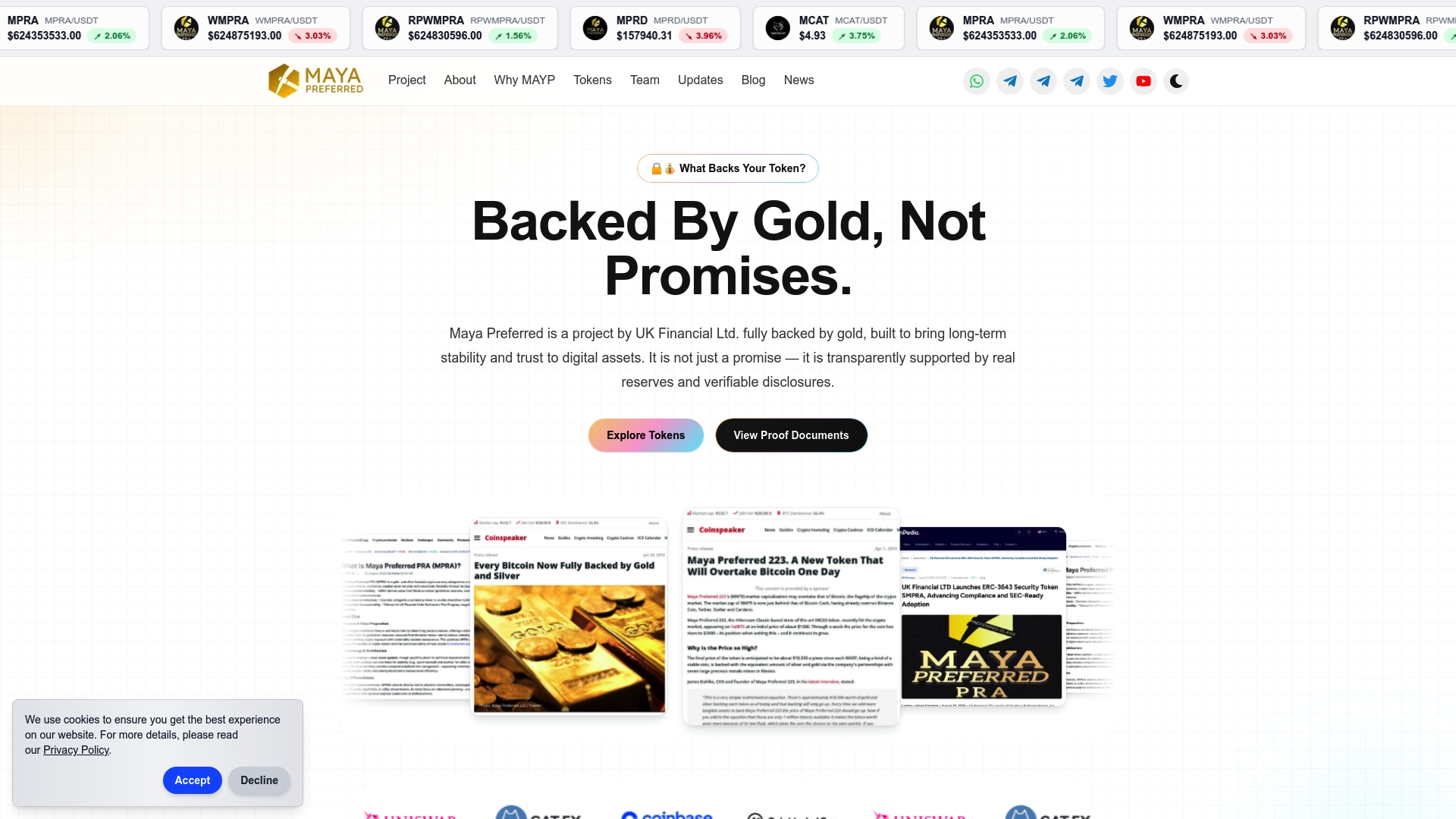
Take control of your digital gold exposure today. Visit Maya Preferred for detailed disclosures and trade-ready tokens. Learn more about our commitment to transparency and stable crypto assets on the official site and join a community that values real-world backing and regulatory insight.
Frequently Asked Questions
What are gold-backed cryptocurrencies?
Gold-backed cryptocurrencies are digital currencies that are pegged to the value of physical gold. Each token typically represents a specific amount of gold, making it easier to trade and hold gold assets in a digital format. To explore these options, research various projects and evaluate their backing mechanisms and regulatory compliance.
How do I assess the stability of a gold-backed cryptocurrency?
To assess the stability of a gold-backed cryptocurrency, review its asset backing, audit history, and the credibility of the issuing entity. Look for transparent disclosures and third-party audits that confirm the collateral it claims to hold. Start by analyzing project websites and documentation for these critical elements.
What features should I look for in a gold-backed cryptocurrency?
Key features to consider include the mechanism of gold backing (e.g., 1:1 peg), governance structure, transaction speed, and availability on trading platforms. Additionally, ensure the project provides regular audit reports and legal compliance information. Compile a checklist of features to compare different cryptocurrencies effectively.
Can I redeem gold-backed cryptocurrency for physical gold?
Many gold-backed cryptocurrencies offer redemption options for physical gold, though the process and conditions can vary by project. Check the specific terms and conditions for each cryptocurrency to understand redeemability and any associated fees. Make a note of the redemption process to ensure you can access your gold when desired.
Are gold-backed cryptocurrencies suitable for long-term investment?
Gold-backed cryptocurrencies can be suitable for long-term investment, offering a hedge against inflation and stability due to their tangible backing. Create a strategy based on your financial goals and risk tolerance, factoring in the project’s credibility and historical performance. Monitor market trends regularly to determine when to adjust your holdings.
How can I compare different gold-backed cryptocurrencies?
To compare different gold-backed cryptocurrencies, evaluate criteria like their asset backing, governance models, transaction costs, and user experience. Consider compiling a side-by-side comparison chart that notes key features, audit status, and market performance. This approach can help you make an informed investment decision.