
Why Choose Stablecoins in 2025: Real Asset Value

Market swings can test even the most seasoned Asia-Pacific investors, especially when digital assets seem in constant flux. For those seeking steadier ground in 2025, asset-backed stablecoins tied to gold and silver reserves are gaining attention as a way to blend cryptocurrency convenience with traditional stores of value. While these coins promise greater consistency than typical crypto, research from the IMF and Bank for International Settlements confirms that stability is not absolute, making careful evaluation of each coin’s backing and guarantees essential.
Table of Contents
- Stablecoins Defined And Common Misconceptions
- Types Of Stablecoins: Asset-Backed Versus Algorithmic
- How Gold And Silver-Backed Stablecoins Work
- Real-World Applications For Investors In 2025
- Risks, Regulatory Issues, And Market Transparency
- Comparing Stablecoins To Other Crypto Options
Key Takeaways
| Point | Details |
|---|---|
| Stablecoin Limitations | Stablecoins are not absolutely stable; they can experience fluctuations, especially during market stress. Understanding the backing and redemption guarantees is crucial for investors. |
| Asset-Backed vs Algorithmic | Distinguish between asset-backed stablecoins, which offer tangible value, and algorithmic stablecoins, which rely on supply adjustments. Asset-backed options usually provide greater security and reliability. |
| Real-World Applications | Stablecoins facilitate faster and cheaper cross-border transactions while offering a hedge against currency depreciation. Their use is increasing in automated trading and collateral management. |
| Due Diligence is Essential | Investors must verify stablecoin issuer claims through audits and transparent redemption processes to mitigate risks associated with reserve backing and regulatory compliance. |
Stablecoins Defined and Common Misconceptions
A stablecoin is a digital asset designed to maintain a consistent value by pegging itself to a reference asset, typically a fiat currency like the US Dollar, or increasingly, to tangible assets such as precious metals. Unlike volatile cryptocurrencies that swing wildly based on market sentiment, stablecoins aim to eliminate price fluctuations that make traditional crypto unsuitable for everyday transactions and savings. For investors in the Asia-Pacific region seeking to preserve wealth while maintaining exposure to digital assets, this stability offers a compelling alternative to holding currencies alone, particularly when those stablecoins are backed by verifiable reserves like gold or silver rather than mere algorithmic promises.
However, a critical misconception exists around the term itself. Many assume that “stable” means “absolutely stable” with guaranteed price parity at all times. The reality is more nuanced. Research from the IMF indicates that stablecoins do not guarantee absolute value stability, and fluctuations can and do occur during periods of market stress or low liquidity. Similarly, the Bank for International Settlements clarifies that stablecoins do not maintain perfect parity with their peg at all times, and many lack redemption guarantees that would make them equivalent to holding the underlying asset directly. A stablecoin losing 2 percent of its value during volatility spikes is still vastly different from a cryptocurrency that might plummet 30 percent overnight, but it is not literally stable in the way a fixed deposit at a bank would be.
Another widespread misunderstanding centers on the type of backing. Not all stablecoins are equal. Some operate on trust in a central issuer without published reserve verification, while others employ algorithmic mechanisms with minimal real asset backing. Asset-backed stablecoins, particularly those secured by precious metals held in verified accounts, represent a different category entirely. For Asia-Pacific investors accustomed to understanding tangible value in physical gold and silver holdings, asset-backed tokens offer transparency that other stablecoins cannot match. When you hold a stablecoin backed by allocated gold reserves, you possess a claim to a specific, verifiable quantity of that metal, which introduces a layer of certainty absent from many alternatives.
These distinctions matter profoundly when evaluating stablecoins for long-term value preservation. The stability these instruments provide comes with specific conditions, limitations, and operational characteristics that vary widely across projects and issuers. Understanding precisely what you are holding, how it is backed, and what guarantees accompany it determines whether a stablecoin truly serves your investment objectives.
Pro tip: Always verify a stablecoin’s backing mechanism through published audits and reserve documentation before allocating significant capital. A stablecoin backed by allocated precious metals with transparent proof of reserves offers substantially more security than one relying solely on issuer claims.
Types of Stablecoins: Asset-Backed Versus Algorithmic
When evaluating stablecoins for your investment strategy, understanding the fundamental differences between asset-backed and algorithmic models becomes essential. Asset-backed stablecoins are collateralized by tangible or financial reserves held in custody, providing investors with a direct claim on real value. These reserves can include fiat currency deposits, commodities like gold and silver, or even other cryptocurrencies. For Asia-Pacific investors drawn to precious metals as stores of value, asset-backed stablecoins secured by allocated gold or silver offer a bridge between traditional metal ownership and digital asset management. You own a stablecoin backed by physical gold because that gold actually exists in a verified vault, not because some algorithm promises stability through mathematical mechanisms.
Algorithmic stablecoins, by contrast, operate without substantial reserves backing them. Instead, they maintain price stability through automated supply adjustments and economic incentives encoded into smart contracts. When demand for the token exceeds supply, the algorithm increases supply to push the price down. When demand drops, it decreases supply to push the price up. This approach resembles how derivatives work in traditional finance, creating synthetic stability rather than collateral-based stability. Research comparing stablecoin mechanisms and implementations reveals that algorithmic stablecoins rely on complex economic models that can unravel during market stress, whereas asset-backed coins mimic traditional financial instruments with proven track records.
The practical implications for your investment decisions are substantial. Asset-backed stablecoins typically offer greater perceived reliability because the backing asset provides a real floor value and redemption path. If an issuer faces problems, you can theoretically redeem your tokens for the underlying asset. Algorithmic stablecoins, conversely, are more vulnerable to systemic risks and can collapse if market participants lose confidence in the underlying economic model. A systematic review of stablecoin types confirms that asset-backed models tend to demonstrate superior stability during volatile market conditions, while algorithmic approaches expose investors to higher structural risk despite their technical innovation.

For investors prioritizing capital preservation and transparency, this distinction determines everything. Asset-backed stablecoins pegged to precious metals deliver measurable backing that can be audited independently. You can verify that allocated gold exists. You cannot verify that an algorithm will function as intended during the next market crisis. Understanding your specific risk tolerance and investment objectives guides which model aligns with your needs.
Here is a comparative overview of asset-backed versus algorithmic stablecoins:
| Characteristic | Asset-Backed Stablecoins | Algorithmic Stablecoins |
|---|---|---|
| Collateral Type | Physical assets or fiat held in reserve | No substantial collateral; uses code |
| Transparency | Backing can be audited and verified | Reliant on algorithmic transparency |
| Risk During Market Stress | Value floor from collateral limits downside | Can lose peg quickly and collapse |
| Redemption Mechanism | Convertible to underlying asset or currency | No direct redemption; relies on demand |
| Typical User Preference | Investors seeking reliability and audit trail | Users pursuing innovation, higher risk |
Pro tip: When comparing asset-backed stablecoins, prioritize those offering redemption rights, third-party audit verification of reserves, and allocated (not pooled) precious metal holdings to maximize your claim certainty.
How Gold and Silver-Backed Stablecoins Work
Gold and silver-backed stablecoins operate on a straightforward principle that bridges traditional precious metals investment with modern blockchain technology. When you acquire a gold or silver-backed stablecoin, you receive a digital token representing a claim to a specific quantity of the underlying metal held in secure custody. The issuer purchases and stores physical gold or silver in allocated accounts, meaning your metal is segregated and identifiable rather than pooled with other investors’ holdings. This allocation creates a direct ownership relationship. Your stablecoin equals your metal. To maintain price stability, the issuer continuously monitors the market value of the underlying precious metals and adjusts token issuance to ensure the stablecoin price remains pegged to the actual metal value. Research detailing commodity-backed stablecoins and their mechanisms confirms that these coins benefit from intrinsic asset value while gaining transaction efficiency through blockchain technology.
The process works through several interconnected steps. First, when you want to purchase a gold-backed stablecoin, the issuer uses your funds to buy physical gold on the spot market and deposits it into a custodian-held vault. The custodian, typically a reputable precious metals storage facility or bank, maintains segregated accounts and provides regular audit documentation proving the metal exists and is accounted for. Second, the issuer mints an equivalent number of digital tokens representing your claim to that metal. These tokens trade on blockchain networks, allowing you to send, store, and trade them with the same ease as any other cryptocurrency. Third, redemption rights enable you to convert your tokens back into physical metal or fiat currency at any time, creating a defined floor value. This three-step cycle explains why gold and silver-backed stablecoins provide investor confidence that simple algorithmic stablecoins cannot replicate.
Transparency mechanisms distinguish quality issuers from unreliable ones. The architecture of these stablecoins requires custody verification and redemption procedures that enable independent audits confirming the metal actually exists. Reputable issuers publish regular proof-of-reserves statements showing the metal balance, audit certifications from third-party firms, and redemption history demonstrating actual conversions occur. For Asia-Pacific investors accustomed to verifying precious metals holdings through hallmark certificates and assay reports, this transparency model feels familiar. You can request audits. You can verify storage. You can redeem physical metal if you choose. The blockchain provides transaction permanence, while the metal provides intrinsic value. This combination addresses the core concern many traditional investors have about cryptocurrency: where is the actual value?
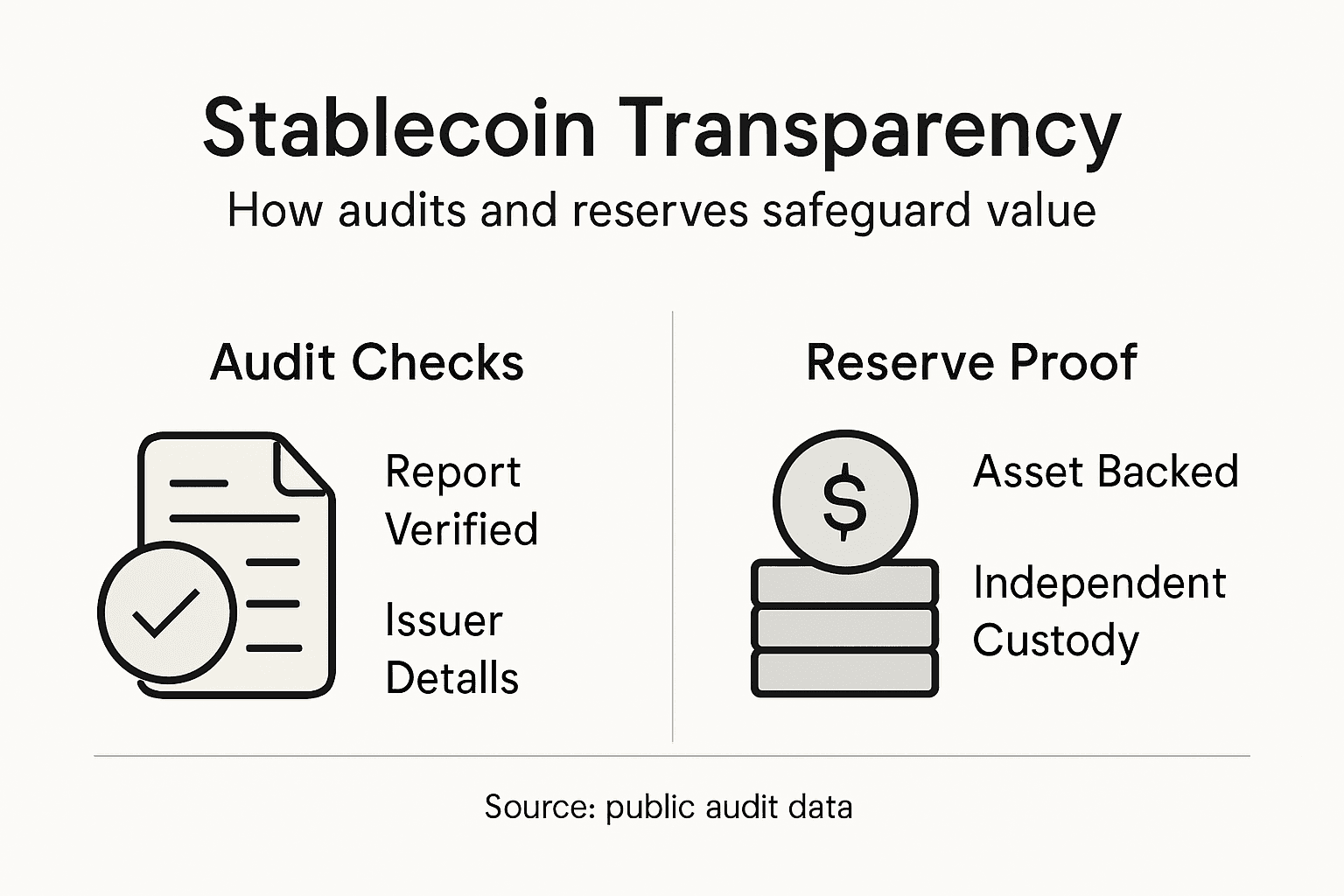
The following table summarizes how gold and silver-backed stablecoins function and benefit investors:
| Step/Feature | Purpose | Investor Benefit |
|---|---|---|
| Vaulted Metal Storage | Secures specific quantity of precious metal | Provides real, segregated ownership |
| Blockchain Token Issuance | Links physical metal to digital token | Enables global, fast transfers |
| Redemption Rights | Allows conversion to physical metal or cash | Ensures liquidity and value certainty |
| Regular Third-Party Audits | Verifies existence and safety of reserves | Delivers confidence and transparency |
Pro tip: Before committing capital to a gold or silver-backed stablecoin, request the most recent third-party audit report, verify the custodian’s reputation and insurance coverage, and confirm that redemption rights allow conversion to physical metal at a clearly specified cost.
Real-World Applications for Investors in 2025
Stablecoins have transitioned from theoretical blockchain constructs to practical financial instruments serving multiple investor needs in 2025. The most immediate application involves cross-border remittances and international payments. Instead of waiting days for traditional wire transfers while paying substantial fees to intermediaries, you can send value across borders in minutes using stablecoins. For Asia-Pacific investors with family or business connections across multiple countries, this capability eliminates the friction that makes traditional banking expensive for regular transfers. A Singapore-based investor sending money to Vietnam no longer needs to convert Singapore dollars to US dollars, wait for clearing, and then convert again. Direct stablecoin transfers accomplish the same goal at a fraction of the cost and time. Beyond remittances, gold and silver-backed stablecoins specifically offer portfolio diversification with intrinsic asset backing. Where traditional stablecoins pegged to fiat currencies expose you to currency risk and inflation, precious metals-backed tokens maintain value tied to real commodities that have preserved purchasing power across centuries.
Liquidity management represents another critical application gaining momentum in 2025. When you hold volatile cryptocurrencies or equity positions, stablecoins provide a bridge asset for rapid rebalancing without exiting the digital ecosystem entirely. You can quickly convert profits from one position into a stable asset, evaluate market conditions, and redeploy capital without the slippage and fees associated with converting to fiat and back. Research on stablecoins in decentralized finance applications confirms their widespread use in automated trading, liquidity provision, and collateral management across blockchain platforms. Asset-backed stablecoins enhance this utility by providing collateral with transparent backing rather than relying on algorithmic stability mechanisms. Many decentralized lending platforms now accept gold or silver-backed stablecoins as superior collateral compared to fiat-pegged alternatives.
Hedging against currency depreciation addresses a specific concern for Asia-Pacific investors. If you hold wealth in a currency experiencing inflationary pressure or geopolitical uncertainty, converting portions into gold-backed stablecoins locks in metal value without requiring physical metal storage, insurance, and logistics. You maintain exposure to precious metals with blockchain’s efficiency. The IMF analysis of stablecoin applications in payment systems and remittances emphasizes reduced transaction costs and faster settlements while enabling financial inclusion for those outside traditional banking systems. Additionally, institutional investors increasingly use stablecoins for improved collateral efficiency and access to global markets. Whether you seek to diversify geographical exposure or participate in international DeFi opportunities, stablecoins eliminate barriers that previously required substantial capital for international brokerage accounts and currency conversion.
Pro tip: Start with smaller position sizes in stablecoins to understand redemption mechanics, custody procedures, and platform interfaces before committing significant capital, allowing you to verify all claims about backing and stability in real trading conditions.
Risks, Regulatory Issues, and Market Transparency
Despite their advantages, stablecoins carry genuine risks that investors must understand before committing capital. The most fundamental concern involves reserve backing verification. Not all stablecoins maintain the full reserves they claim. Some issuers operate with fractional reserves, meaning they hold only a portion of the assets supposedly backing tokens in circulation. Others lack independent audits entirely, relying instead on internal claims about reserve levels. For precious metals-backed stablecoins, this risk manifests as the possibility that allocated gold supposedly held in your name actually does not exist or has been rehypothecated (lent out) without your knowledge. Stablecoin financial and operational vulnerabilities include inadequate reserve documentation, weak custody oversight, and inconsistent governance structures that leave investors exposed when issuers face liquidity crises. A stablecoin audit conducted two years ago means nothing if reserves were subsequently depleted through poor management or fraud.
Regulatory fragmentation creates another significant challenge. Different countries classify and regulate stablecoins differently, and this patchwork approach creates uncertainty about which rules apply to you as an Asia-Pacific investor. Some jurisdictions require stablecoin issuers to maintain banking licenses and comply with stringent capital requirements. Others impose restrictions on cross-border transfers or prohibit stablecoins entirely. The United States, European Union, Singapore, and Australia have all proposed or implemented different regulatory frameworks, leaving global investors navigating conflicting requirements. Regulatory approaches addressing stablecoin risks remain incomplete across most jurisdictions, with governments still developing comprehensive disclosure standards and issuer accountability mechanisms. This regulatory uncertainty means that a stablecoin legal in your country today could face restrictions tomorrow, potentially affecting your ability to redeem or transfer holdings.
Market transparency issues compound these challenges. Even when issuers publish reserve documentation, standardized formats do not exist for comparing different stablecoins. One issuer might report allocated reserves in one way while another uses completely different metrics, making meaningful comparison impossible. Redemption guarantees vary wildly. Some stablecoins promise immediate physical redemption at cost, while others require waiting periods or impose conversion fees that undermine stability during market stress. The lack of standardized operational resilience standards means you cannot easily assess whether an issuer can handle payment system disruptions, custody failures, or sudden redemption surges. Precious metals-backed stablecoins require specific scrutiny around storage location, insurance coverage, segregation guarantees, and the custodian’s financial health. A vault holding your allocated gold means nothing if that vault’s operator becomes insolvent.
These risks do not mean stablecoins are unsuitable investments. Rather, they demand rigorous due diligence before allocating significant capital. Prioritize issuers offering quarterly third-party audits from reputable firms, transparent redemption mechanics with clearly stated fees, and custody arrangements with established institutions carrying substantial insurance coverage. Verify that your stablecoin issuer maintains operational redundancy, published risk management policies, and regulatory compliance in your jurisdiction.
Pro tip: Request detailed written redemption procedures, confirm custody insurance specifics, and verify the auditor’s independence and qualifications before investing, as these three factors reveal more about actual risk than marketing materials ever will.
Comparing Stablecoins to Other Crypto Options
When building a digital asset strategy, understanding how stablecoins differ from traditional cryptocurrencies like Bitcoin or Ethereum fundamentally shapes your allocation decisions. The core distinction centers on volatility and use case. Bitcoin and Ethereum function primarily as speculative assets and stores of value whose prices fluctuate based on market sentiment, adoption trends, and macroeconomic conditions. A Bitcoin investor accepts 10 to 20 percent daily price swings as normal. By contrast, stablecoins aim to eliminate this volatility by maintaining a consistent price through asset backing or algorithmic mechanisms. For Asia-Pacific investors seeking capital preservation rather than speculative gains, this difference is not trivial. Holding Bitcoin requires conviction that digital assets will appreciate over time. Holding a gold-backed stablecoin requires only confidence that gold retains value, a proposition with centuries of historical evidence.
The volatility trade-off involves another consideration: decentralization versus stability. Cryptocurrency comparison analysis reveals that stablecoins often sacrifice complete decentralization for value stability. Bitcoin operates on a fully decentralized network where no single entity controls supply or issuance. Most stablecoins, particularly asset-backed ones, rely on centralized issuers maintaining reserves and managing redemptions. You gain price stability but lose some decentralization benefits. For Asia-Pacific investors focused on wealth preservation, this trade-off makes sense. You prefer an issuer you can audit and hold accountable to maintaining reserves over a decentralized system promising stability through mathematical complexity that may or may not function during stress periods.
Purpose fundamentally divides these asset classes. Traditional cryptocurrencies serve as investment vehicles and speculative positions. Stablecoins function as payment and transaction instruments designed for reliable value transfer and savings. This distinction matters for portfolio construction. If your goal involves sending remittances to family members, paying for goods, or temporarily holding value between investments, stablecoins excel. If your goal involves capturing upside from cryptocurrency adoption or betting on blockchain technology maturation, traditional cryptocurrencies offer more leverage. Many sophisticated investors maintain both positions: holding Bitcoin or Ethereum as long-term speculative bets while using stablecoins for operational efficiency and volatility management. Gold and silver-backed stablecoins occupy a unique position combining stablecoin functionality with precious metals characteristics that appeal specifically to Asia-Pacific investors accustomed to metal ownership.
Adoption patterns reflect these functional differences. Bitcoin remains primarily a store of value held by retail and institutional investors. Stablecoins increasingly dominate actual transaction volumes, cross-border payments, and decentralized finance platforms where stable value matters more than speculative upside. As regulatory frameworks solidify around stablecoins in 2025, institutional capital flows increasingly favor them over volatile cryptocurrencies for operational purposes, further widening the segmentation between these asset classes.
Pro tip: Allocate stablecoins for transaction efficiency, portfolio rebalancing, and stability, while reserving speculative cryptocurrency positions for capital you can afford to lose if your conviction on adoption thesis proves wrong.
Secure Your Wealth with Real Asset-Backed Stablecoins Today
The article highlights critical challenges investors face when seeking stability and transparency in the volatile crypto market. If you are concerned about stablecoins that lack verifiable backing or worry about unpredictable value fluctuations during market stress, you are not alone. Many investors desire the assurance that comes from physical collateral, especially gold and silver, that anchoring your digital assets gives you real, measurable value and redemption rights. At Maya Preferred, we understand these pain points and offer gold and silver-backed digital tokens that deliver exactly that. Unlike algorithmic stablecoins or those without clear audits, our blockchain project provides full transparency, verified proofs of allocated precious metals reserves, and trusted custody arrangements that build long-term confidence.
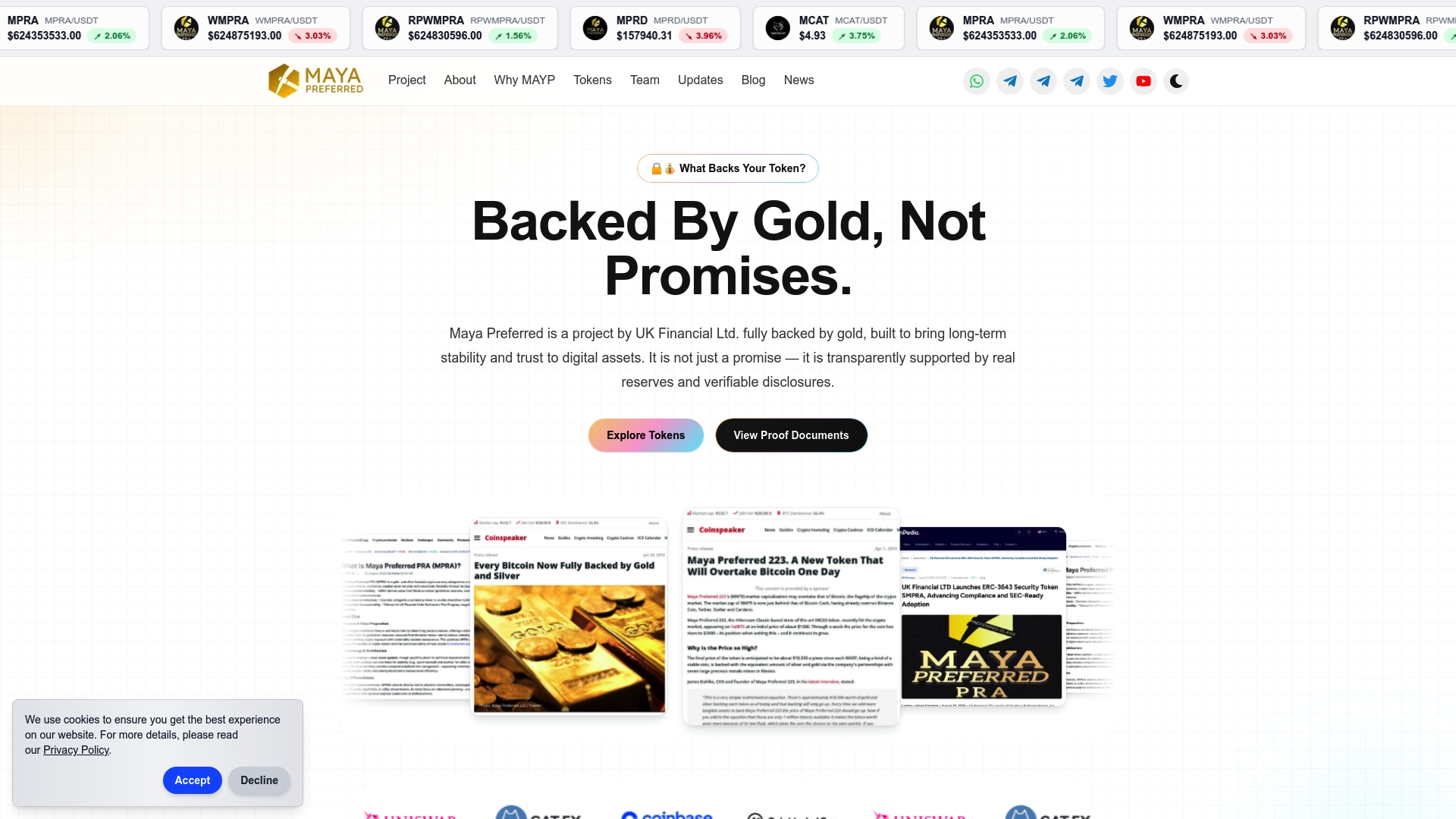
Experience the stability and trust that come from owning stablecoins backed by real precious metals. Visit Maya Preferred now to explore tokens like MPRA, MPRD, and MCAT. Access detailed audit reports, transparent disclosures, and clear redemption procedures on our site to make informed investment decisions. Don’t wait for uncertainty to erode your capital—claim your position in a future where blockchain technology meets tangible asset value. Take control of your financial security today by learning more at Maya Preferred’s landing page, review our proof of reserves and audits, and join a community dedicated to trust, transparency, and stability.
Frequently Asked Questions
What are stablecoins, and why are they considered valuable in 2025?
Stablecoins are digital assets designed to maintain a stable value by pegging to real assets like fiat currencies or commodities, such as gold and silver. They are valuable in 2025 for preserving wealth, facilitating transactions, and providing liquidity without the volatility commonly associated with traditional cryptocurrencies.
How do gold and silver-backed stablecoins work?
Gold and silver-backed stablecoins represent a digital claim to a specific quantity of the underlying precious metals held in secure custody. They allow investors to enjoy the benefits of blockchain transactions while maintaining value linked to tangible assets.
What are the risks associated with investing in stablecoins?
Investing in stablecoins carries risks related to reserve verification, regulatory uncertainty, and market transparency. Some stablecoins may not maintain full reserves as claimed, and the lack of standardized regulations increases the potential for fluctuation and unreliability.
How do stablecoins compare to traditional cryptocurrencies like Bitcoin or Ethereum?
Stablecoins aim to eliminate volatility and function primarily as payment and transaction tools, while traditional cryptocurrencies like Bitcoin and Ethereum are often considered speculative assets with significant price fluctuations. Investors typically use stablecoins for transactions, while traditional cryptocurrencies may serve as long-term investments.